Cold Room Cost per Square Meter: What Actually Drives the Number
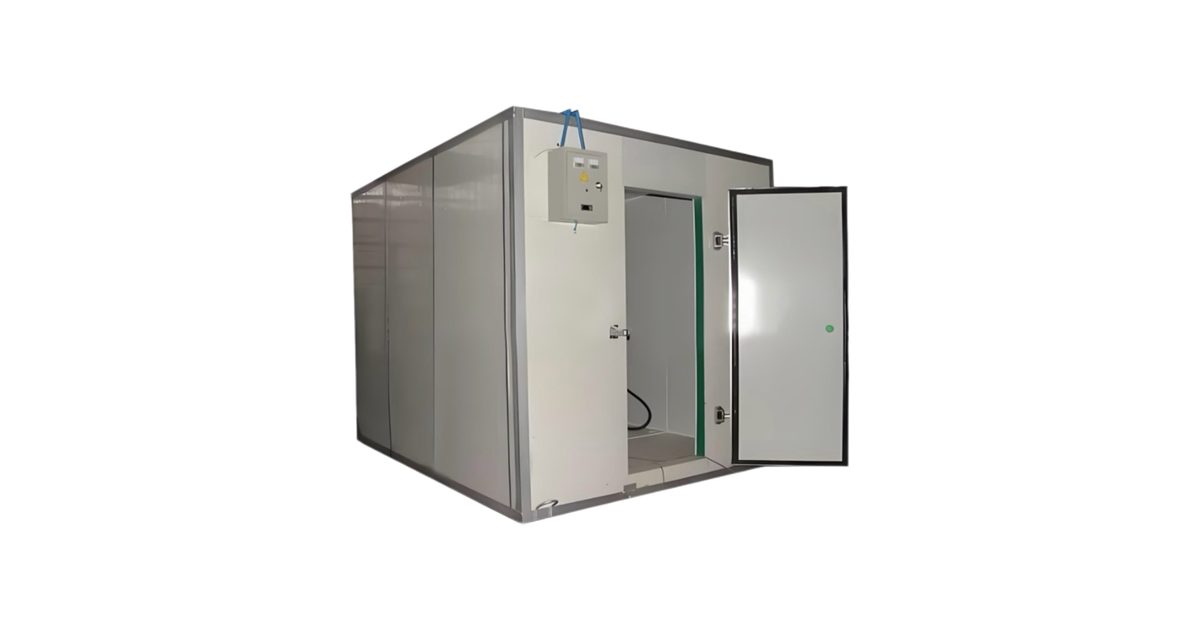
"Cold room cost per square meter" is the most searched question in this industry, and it is also the one question no honest manufacturer can answer in a single number.
The reason is structural: a cold room is not a product with a unit price, it is a small building with a refrigeration plant attached. Two rooms of exactly 200 m² can differ by a factor of three depending on the temperature, the panel specification, the equipment brand and what the quote actually includes.
What follows is the breakdown that lets you judge a quotation on your own — which components matter, which variables move the number most, and where the cheapest quote usually hides its cost.
Part 1: What a cold room quote is actually made of
Before comparing numbers, separate the eight components. Most "per square meter" figures you see online only cover one or two of them.
| # | Component | What it covers | Typical share of total |
|---|---|---|---|
| 1 | Insulated panels | Walls, ceiling, floor panels, PU core | Largest single item |
| 2 | Refrigeration unit | Compressor / condensing unit | Varies widely by brand |
| 3 | Evaporators (air coolers) | Unit coolers inside the room | Scales with room volume |
| 4 | Doors | Door leaf, frame, hardware, heaters | Scales with door count |
| 5 | Controls & electrical | Control panel, sensors, cabling, installation | Often underestimated |
| 6 | Floor works | Insulation, vapour barrier, screed, anti-frost | Hidden cost on freezer rooms |
| 7 | Installation labour | Assembly, sealing, commissioning | Region-dependent |
| 8 | Freight & packaging | Domestic or export crating | Material on export orders |
Engineering tip: When a supplier quotes a single "per m²" figure, ask which of these eight are inside it. In practice, most low headline numbers include items 1 and 2 only. Items 5, 6 and 7 are what turn a cheap quote into an expensive project.
Part 2: The seven variables that move the number most
Ranked roughly by how much they shift the total.
1. Target temperature — the single biggest driver
Every degree lower costs money twice: thicker panels, and a larger refrigeration plant.
| Room type | Temperature | Panel thickness | Equipment load |
|---|---|---|---|
| Chiller / fresh produce | 0°C to +10°C | 100 mm | Lowest |
| Cold store | -18°C to -20°C | 120–150 mm | Moderate |
| Blast freezer | -30°C to -40°C | 150–200 mm | Highest |
A blast freezer can cost two to three times a chiller room of the same footprint. If you are budgeting from a per-m² figure you found online, confirm which temperature band it came from.
2. Surface-to-volume ratio (room shape)
This is the variable buyers overlook most. Heat enters through the *surface*, but you pay for the *volume*.
A 5 m × 5 m room and a 2 m × 12.5 m room are both 25 m², but the long narrow one has far more wall area and therefore more heat gain and more panel area. Tall rooms behave differently again — a 6 m high room has more volume per unit of floor area, which is why large warehouses cost less per m² than small rooms.
Rule of thumb: cost per cubic metre is more meaningful than cost per square metre. If your room is small or unusually shaped, expect the per-m² figure to be well above average.
3. Panel specification
Not all "100 mm PU panel" is the same.
- Density — 40 vs 45 kg/m³ changes both cost and long-term dimensional stability
- Facing material — colour steel, stainless, or food-grade finishes
- Core — standard PU vs higher fire-rating formulations
Engineering tip: Panel density is the easiest place for a low quote to save money while still printing "100 mm" on the spec sheet. Always specify thickness and density together.
4. Refrigeration equipment brand and configuration
The spread between an entry-level compressor and a Bitzer or Danfoss-based unit is substantial. So is the difference between a single unit and a rack or parallel system with capacity control.
This is also where the -18°C trap sits: cooling capacity is only comparable once the evaporating temperature is stated. A unit quoted at 15 kW at -10°C may deliver only 9 kW at -25°C, while a competitor's 12 kW at -25°C is the stronger machine. Never compare kW figures without the operating condition attached.
5. Door count and type
Each door is both a capital cost and a permanent heat leak. A manual sliding door, an electric sliding door and a high-speed roll-up door differ by an order of magnitude.
For freezer rooms, the door frame heater is not optional — omit it and the door freezes shut. Confirm heater power is sized to the opening perimeter, not just "heaters included".
6. Floor construction
On freezer rooms, the floor is a genuine engineering item, not a slab. It needs insulation, a vapour barrier and — for rooms below 0°C — protection against frost heave, which can lift and crack a floor if the ground beneath it freezes.
Floor works are frequently excluded from equipment-only quotes. Ask explicitly.
7. Local labour and compliance
Installation cost varies by region. So do electrical codes, refrigerant regulations and fire requirements. For the US market, note that refrigerant rules (EPA SNAP), electrical listing (UL/ETL) and energy standards vary by state and application.
⚠️ *Compliance requirements must be confirmed against your local jurisdiction and the specific application. Treat any statement about certification as a question to ask the supplier, not a given.*
Part 3: Reference ranges — replace with your own quotation
⚠️ The figures below are placeholders. Replace them with your actual quotation before publishing. Publishing a number you cannot honour is worse than publishing none: overseas buyers will quote it back at you in the first email, and a mismatch there costs more credibility than the figure ever gained.
| Room type | Equipment-only indication | Installed, turnkey indication |
|---|---|---|
| Chiller room (0 to +10°C) | ⚠️ replace with your actual quotation | ⚠️ replace with your actual quotation |
| Cold store (-18°C) | ⚠️ replace with your actual quotation | ⚠️ replace with your actual quotation |
| Blast freezer (-35°C) | ⚠️ replace with your actual quotation | ⚠️ replace with your actual quotation |
Use this table as a *structure* for your own numbers rather than as data. What buyers need to see is that you have separated the cases, not a single number pretending to cover all three.
Part 4: Why the lowest quote is rarely the lowest cost
A cold room runs for ten to twenty years. Purchase price is a fraction of lifetime cost.
Consider where the money goes over that period:
| Low-spec build | Correctly specified build | |
|---|---|---|
| Purchase price | Lower | Higher |
| Panel performance | Thinner / lower density | Matched to temperature |
| Door sealing | Basic, single lip | Double lip, EPDM at low temp |
| Energy consumption | Higher, continuously | Lower, continuously |
| Door / seal failures | Frequent from first winter | Rare |
| Temperature stability | Wider swings | Tighter control |
On a room that runs every day, the energy penalty of under-specified insulation and leaking doors compounds annually. The money saved on the door and the panels is typically paid back within a couple of years through the electricity bill.
This is not an argument for the most expensive quote. It is an argument for comparing quotes on specification, not on headline price.
Part 5: What to send a supplier to get a comparable quote
The fastest way to a meaningful number is to give the supplier enough to design against. Send these eight items:
- Room dimensions — length × width × height (internal)
- Target temperature — and whether it is storage or freezing-down
- Product — what is stored, incoming temperature, daily turnover
- Door count and size — and whether forklifts or pedestrians use them
- Panel preference — thickness and density, or ask for recommendation
- Equipment brand preference — or state "open"
- Power supply available — voltage, phase, frequency
- Installation — who installs, and whether floor works are in scope
A quotation returned from this list can be compared line by line against another. A quotation returned from "200 m² cold room, please quote" cannot — and the cheapest of those is usually the one that left the most out.
The short version
Per-square-metre pricing is a starting point for budgeting, not a basis for choosing a supplier. The number is driven by temperature first, then by room geometry, panel specification and equipment brand — and it only means anything once you know which of the eight components are inside it.
Ask for the quote in components. Compare specifications, not totals. And be sceptical of any figure that arrives without an evaporating temperature, a panel density or a door heater attached to it.
*Shandong Boruite Refrigeration Equipment Co., Ltd. manufactures PU insulation panels and cold room doors in-house and handles design, equipment supply, installation and after-sales for cold storage projects. Factory: Boxing County, Binzhou, Shandong, China. Tel: +86 15898896999 · Email: 3107900547@qq.com*
*Technical values in this article are general industry reference figures. Final selection must be calculated against actual project conditions.*
Send us the product, storage volume, target temperature and site conditions — our engineers will come back with a preliminary scheme and budget range within 24 hours.
Email us 15898896999