Cold Room Insulation Panels: Thickness, Density and What Buyers Get Wrong
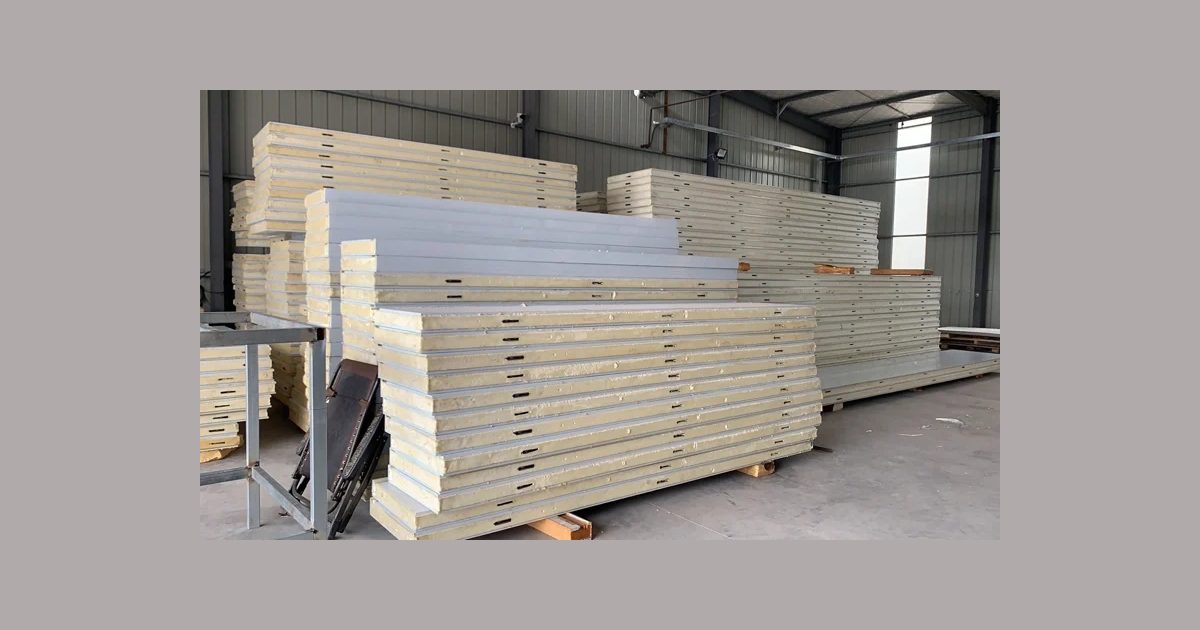
Panels are the cheapest line item to downgrade and the most expensive one to live with. A slightly thinner or lighter panel looks identical on a quotation, passes a visual inspection on site, and then adds to the electricity bill every single month for the life of the room.
This is what to specify, and what suppliers leave unsaid.
Thickness follows temperature, not budget
Panel thickness is not a quality choice — it is a calculation. The colder the room, the larger the temperature difference across the panel, and the more resistance the insulation has to provide.
| Storage temperature | Typical panel thickness |
|---|---|
| +10 to 0 °C (chilled, fruit and vegetables) | 75–100 mm |
| 0 to −5 °C (fresh / meat holding) | 100 mm |
| −18 to −20 °C (frozen storage) | 150 mm |
| −25 to −30 °C (fast freezing, blast) | 150–200 mm |
These are working ranges, not rules — the final figure depends on ambient climate, how often the doors open, and whether the room is indoors or in direct sun. A room in a hot, humid coastal climate needs more than the same room in a temperate one.
The trap: a quotation that says "150 mm panel" for a −18 °C room and another that says "100 mm" are not comparable offers. The second one is not cheaper; it is a different room. It will cost more to run, and the difference compounds for a decade.
Density is the number nobody writes down
Two panels can both be labelled "100 mm PU" and perform very differently. What separates them is density, measured in kg/m³.
- 38–40 kg/m³ — the common commercial grade. Adequate for many rooms, widely used.
- 40–42 kg/m³ — better dimensional stability, higher compressive strength, better insulation consistency, slower ageing.
- Below 36 kg/m³ — cheaper to make, and it shows up as lower compressive strength, more shrinkage over time, and thermal performance that drifts as the foam ages.
Ask for the measured bulk density, not the grade name. In this industry a panel sold as 40 kg/m³ that measures 35 is not unusual, and foam density is not something you can check by eye on site. A reputable manufacturer will put the test value on the datasheet.
Engineering tip — how to make density enforceable Do not ask "what density is it?". Write it as an acceptance criterion instead: "density ≥ 40 kg/m³, verified by test report attached to the shipment; panels below this value are rejected." The first version gets you a verbal number you cannot check later. The second gives you grounds to reject a container on arrival — and once a supplier knows you will test, the quoted number tends to be honest. Ask for the report per batch, not per order.
There is a practical second-order effect: higher-density panels also hold their shape better, which keeps the cam-lock joints tight. Loose joints are where the cold actually escapes (see below).
Fire rating and facing material
Fire rating. PU cores are combustible; the classification (typically B1/B2 under Chinese GB 8624, or Euroclass B-s1,d0 / B-s2,d0 under EN 13501) is about how the panel behaves in a fire, not whether it burns. Insurers, food-industry auditors, and some local authorities specify a minimum class. Check what your insurer and your customer's audit require before you order — upgrading after installation is not possible.
Facing material. Options include pre-painted galvanised steel, stainless steel (304), and aluminium. For food processing, pharmaceutical, and any room washed down regularly, stainless facing on the interior is worth it. For dry goods and general storage, colour-coated steel is fine and considerably cheaper. Thickness of the steel facing (commonly 0.4–0.6 mm) also affects dent resistance — thin facing on a busy loading dock dents quickly.
| Facing material | Typical application | What to watch |
|---|---|---|
| Pre-painted galvanised steel, 0.4–0.6 mm | Dry goods, general cold storage, budget-sensitive projects | Standard choice; specify coating thickness in coastal or high-humidity sites to avoid early corrosion at cut edges |
| Stainless steel 304 (inner face) | Food processing, pharmaceutical, rooms washed down regularly | Worth the premium where sanitation audits apply; usually only the interior face needs upgrading |
| Aluminium | Humid rooms, some food-grade applications | Good corrosion resistance, softer surface — dents more easily on busy docks |
| Galvanised / plain steel with PVC film | Temporary or low-spec rooms, rooms intended for later upgrade | Cheapest option; expect shorter service life in wet environments |
Engineering tip — specify both faces separately Most specifications say "0.5 mm colour-coated steel" without saying which face. Where hygiene audits apply, upgrading only the interior face to stainless 304 usually captures most of the benefit at a fraction of the cost of a full stainless panel. Ask for the two faces to be quoted as separate line items — it also makes the quotation comparable between suppliers.
The joints leak, not the panels
This is the part most buyers never hear. A cold room is not insulated by panels; it is insulated by panels plus their joints. Poor jointing defeats good panels completely.
Check three things on site:
- Sealant continuity — the bead between panels must be unbroken along the full length. Gaps, however small, become frost lines.
- Corners and roof-to-wall junctions — these are the awkward geometry where shortcuts happen. Ask to see them before the ceiling is closed.
- Pipe and cable penetrations — every penetration needs a sealed sleeve. An unsealed conduit through a panel is a cold bridge and a condensation point.
Also check that panels are not bridging to an uninsulated structure. Where a cold room sits directly on a concrete slab without floor insulation, heat flows in from below continuously — in a −18 °C room this alone can push the plant to run permanently, and over years it causes ground heave that cracks the floor. Floor insulation has to be built in at the start; it cannot be retrofitted.
Engineering tip — the one inspection worth flying out for The critical moment is before the ceiling panels go on. At that point the corner joints, roof-to-wall junctions and penetration sleeves are all visible for maybe half a day. After that they are sealed up for the next fifteen years. Penetration sleeves in particular: any refrigeration pipe, drain line or cable that passes through a panel needs its own sealed sleeve, and these are almost never re-checked once covered. Frost forming at a penetration is expensive to diagnose later because you have to open the room to find it.
Four specification mistakes that cost money for years
1. Specifying thickness but not density. "100 mm PU panel" is an incomplete specification. Always state thickness and minimum density and fire class.
2. Accepting a thickness downgrade to hit a budget. The saving appears once on the invoice; the penalty appears every month on the power bill.
3. Ignoring the floor. Especially for frozen storage. Floor insulation, vapour barrier and a protective wearing layer are separate line items — confirm they exist.
4. Not checking cam-lock condition on delivery. Panels that have been dragged, stacked badly, or stored in the rain arrive with damaged tongue-and-groove edges. Damaged edges do not seal. Inspect on arrival, before installation.
Why the cheapest panel is rarely the cheapest room
The panel is a small share of the project budget and a large share of the lifetime cost, because the panel is what the refrigeration plant has to fight against every hour it runs. Downgrading from 150 mm to 100 mm on a −18 °C room shows up once as a saving on the invoice, and then shows up again every month as heat load the compressor has to remove.
You do not need a full energy model to see this. Ask two suppliers quoting different panels to state the same three numbers — the plant's running power in kW, your local electricity tariff, and the expected daily run hours — and compare the operating cost over five years, not just the equipment price. The ranking often reverses once you do, and the exercise takes an afternoon.
One further check when comparing suppliers: ask where the density figure comes from. A number copied from a general datasheet and a number measured on the batch you are actually buying are two different things, and the gap between them is usually where the saving was made. Asking for the batch test report closes that gap for the price of an email.
What to put in your enquiry
A specification that gets comparable quotes looks like this:
PU sandwich panel, 150 mm, density ≥ 40 kg/m³ (measured), fire class B1, 0.5 mm colour-coated steel both faces, cam-lock, for a −18 °C frozen store. Include floor insulation: 150 mm XPS with vapour barrier and 100 mm concrete wearing layer. Include all joint sealant and penetration sleeves. State panel manufacturer and provide the density test report.
That is one paragraph. It removes most of the ambiguity, and it makes two quotations genuinely comparable.
BRT manufactures PU sandwich panels in-house at our workshop in Boxing County, Shandong, with continuous production lines and density testing on each batch. If you are specifying a room and want the panel datasheet and test report, send us your storage temperature, room dimensions and ambient conditions.
Send us the product, storage volume, target temperature and site conditions — our engineers will come back with a preliminary scheme and budget range within 24 hours.
Email us 15898896999