Cold Room Power Supply for Export: Voltage, Frequency and Phase Explained
A cold room shipped to a site with the wrong electrical supply is not a warranty discussion. It is a stranded asset — a container of panels, a condensing unit that trips its overload, and a buyer who has already paid for installation labour. In export refrigeration the supply specification is an engineering input, exactly like the room temperature or the ambient design condition, and it has to be fixed before the bill of materials is released.
This guide explains what actually changes when equipment rated for 380 V / 50 Hz meets a 440 V / 60 Hz grid, which mismatches a transformer can absorb, which ones it cannot, and what to write in your enquiry so the factory builds the right machine the first time.
Why the supply is an engineering input, not a shipping detail
Compressor capacity is not an absolute number. It is quoted at a defined set of conditions — evaporating temperature, condensing temperature, suction superheat, subcooling, and supply voltage and frequency. Change the frequency and you change the compressor shaft speed, which changes swept volume, mass flow, capacity, absorbed power, discharge temperature and motor current together. A 20 % speed increase is not a 20 % free upgrade; it is a different operating point on the same hardware.
Buyers generally get this wrong in one of two directions. Some assume "50/60 Hz" on a brochure means the unit is universal. Others assume any voltage can be corrected later with a transformer bought locally. Both assumptions cause failures, for different reasons.
⚠️ Everything below describes engineering relationships and typical market values. Quotations, transformer prices and lead times must be replaced with your actual quotation — grid voltages also change between regions and even between industrial estates, so verify against the utility connection at your site, not against a country table.
The four numbers that must all match
Before discussing frequency, confirm all four, because a mismatch in any one of them stops the plant:
- Voltage — nominal and the acceptable band. A "380 V" grid that sits at 415 V at night is a 9 % overvoltage.
- Frequency — 50 Hz or 60 Hz. This is the hard one; it cannot be transformed.
- Phase and wire count — three-phase three-wire (no neutral) or three-phase four-wire with neutral. Most small condensing units need a neutral for the control circuit; a three-wire supply forces a control transformer.
- Available fault level and breaker rating — determines whether your panel can feed the compressor starting current directly.
What changes at 60 Hz — the table buyers should read first
The table below assumes a hermetic or semi-hermetic compressor rated at 400 V / 50 Hz, moved onto a 480 V / 60 Hz supply so that the volts-per-hertz ratio is preserved. That last condition matters and is explained in the first engineering tip.
| Parameter | Change at 60 Hz (voltage scaled with frequency) | Practical consequence |
|---|---|---|
| Motor synchronous speed | +20 % (2-pole 3 000 → 3 600 rpm; 4-pole 1 500 → 1 800 rpm) | Different bearing and valve wear pattern; check compressor speed limit |
| Compressor swept volume | +20 % | Capacity increases roughly in proportion |
| Cooling capacity | +15 % to +20 % | A 20 kW unit becomes a ~23–24 kW unit at the same evaporating temperature |
| Shaft power and current | +15 % to +20 % | Cable and breaker sizing done for 50 Hz is now marginal |
| Evaporator fan power | up to +70 % (fan laws: power varies with the cube of speed) | Fan motors and defrost heaters are the most common 60 Hz casualties |
| Discharge temperature | rises a few kelvin | Matters on freezer duty below −25 °C evaporating |
| Defrost timer / clock functions | synchronous-motor timers run 20 % fast | Electronic controllers with frequency detection are unaffected |
| Control transformer (24 V) | works at 60 Hz, slight derate of regulation | A 50 Hz transformer is generally acceptable at 60 Hz; the reverse is not |
Read the fan row twice. Compressor capacity rises 20 % and the buyer notices the extra capacity. Evaporator fan power rises far more sharply, and those small motors are frequently the first thing to burn out on a wrongly applied export unit.
Engineering tip: the number to preserve is volts per hertz
A 400 V / 50 Hz motor has a V/f ratio of 8.0. A 480 V / 60 Hz supply also has 8.0. That is why North American 460–480 V equipment is the natural 60 Hz counterpart of European 400 V equipment: the magnetic flux in the motor stays the same, so torque capability stays the same, and the motor behaves as designed at the higher speed.
Now run the same 400 V motor on a 440 V / 60 Hz grid without changing the winding. The V/f ratio drops to 7.3, flux weakens, torque capability falls roughly 17 %, and the compressor — which is asking for 20 % more power because it is turning faster — pulls more current to compensate. The overload trips, or the winding cooks slowly over a season. This single relationship explains most "the unit runs fine at home but not on site" complaints in export refrigeration. If your grid is 60 Hz, order a 60 Hz machine built for your voltage; do not assume a 50 Hz nameplate will adapt.
Voltage-only mismatch: when a transformer is the right answer
If the frequency matches and only the voltage differs, a buck-boost or isolation transformer is a clean, cheap fix. Typical cases: 380 V equipment on a 415 V Indian or Middle Eastern supply; 400 V equipment on a 440 V Brazilian or Chilean industrial supply; 380 V equipment on a 480 V North American supply with the frequency already at 60 Hz.
A transformer is not automatic, however, because compressor motors have a narrow tolerance band — usually ±5 % of nameplate voltage continuously, and they tolerate overvoltage worse than undervoltage at part load. Two further points:
- Size for starting, not just running. A transformer must carry the compressor starting current without excessive voltage dip. A practical rule is to size the transformer kVA at roughly 1.25 to 1.5 times the total connected motor kW, then check the starting dip against the compressor contactor's dropout threshold.
- Isolation versus auto-transformer. An auto-transformer is smaller and cheaper; an isolation transformer gives you a separately derived neutral, which is useful when your control circuit needs 220 V single-phase from a three-wire 380 V supply.
⚠️ Transformer costs vary widely by kVA, enclosure rating and local availability — replace with your actual quotation. As an order of magnitude, a transformer and its protection is usually a small fraction of the refrigeration package, which is why voltage mismatch is worth solving properly rather than compromising the compressor selection.
Frequency mismatch: four legitimate routes
There is no transformer for frequency. Your real options are these.
| Route | How it works | Best when | Main risk |
|---|---|---|---|
| Factory 60 Hz build | Compressor, motors, fan and control transformer supplied at 60 Hz and site voltage | Any new order; by far the cheapest correct answer | Requires the supply data up front — the whole point of this article |
| Variable frequency drive | VFD feeds the existing 50 Hz motor at 60 Hz while keeping V/f constant | Retrofit, or one site needing both frequencies | Adds harmonics, needs derating for ambient, changes protection logic |
| Re-rate, not rescale | Keep 50 Hz equipment, accept the capacity and current at 50 Hz, ignore the higher grid frequency by feeding through a fixed-frequency supply | Almost never — only with a dedicated motor-generator set | Cost and losses exceed a correct factory build |
| Derate and protect | Run 60 Hz-rated equipment on 50 Hz, accepting ~15–17 % less capacity | Buyer already owns 60 Hz stock for a 50 Hz site | Capacity shortfall shows up as a room that will not pull down in summer |
In practice, route one is the answer for new equipment in more than 90 % of cases. The reason buyers end up in routes two to four is almost always that the supply specification was never asked for at the enquiry stage.
Typical supply systems by market
Use this only to start a conversation with your electrician; the numbers move between estates and utilities.
| Market | Typical three-phase supply | Frequency | Notes for cold room orders |
|---|---|---|---|
| China, most of Europe, Australia, India, most of Africa | 380 V / 400 V / 415 V | 50 Hz | India commonly 415 V; Australian standard is 400 V |
| Gulf states, Southeast Asia | 380 V / 400 V / 415 V | 50 Hz | Saudi Arabia and UAE now largely 400 V 50 Hz; older 60 Hz plants still exist |
| Philippines, South Korea, China Taiwan, parts of South America | 380 V / 440 V | 60 Hz | 220 V single-phase control circuits are common here |
| Brazil, Mexico, Chile | 380 V / 440 V, sometimes 220 V three-phase | 60 Hz | Multiple regional standards — get the site value in writing |
| United States, Canada | 480 V / 277 V, 208 V / 120 V | 60 Hz | Requires UL/ETL-listed components; see the compliance note below |
| Japan | 200 V / 400 V | 50 Hz east, 60 Hz west | The country is split down the middle; confirm the prefecture |
Compliance note for North America: UL or ETL listing, EPA SNAP rules on acceptable refrigerants, and DOE efficiency requirements all apply to equipment placed on the US market. These are obligations on the equipment and on the importer of record, and they should be raised as questions in the enquiry rather than assumed either way.
Generator supply and site power quality
A large share of export cold rooms in Africa, Southeast Asia and island markets run on generator or on a weak utility feed. Three checks protect the plant:
- Starting current. A direct-on-line compressor pulls five to seven times its running current for a fraction of a second. A generator sized to the running load will stall. Size the set for starting kVA, or specify soft start / star-delta, or a compressor with a part-winding start.
- Voltage dip and phase imbalance. More than 2 % imbalance between phases on a running compressor means uneven winding currents and rapid overheating. Record it at commissioning, not after a failure.
- Changeover between generator and grid. Phase sequence must be identical. A phase-sequence relay on the control panel costs very little and prevents a reversed compressor rotation that destroys a hermetic machine in seconds.
Engineering tip: order the control circuit at the same voltage as the power circuit
The compressor gets all the attention, but the items that most often arrive incompatible are small: 220 V contactor coils on a 380 V three-wire supply with no neutral, 24 V control transformers rated only for 50 Hz, defrost heaters wound for the wrong voltage, solenoid valve coils, and evaporator fan motors in single-phase 220 V. Ask for a control schematic with every coil voltage marked, and check it against the site before the panel is built. Correcting a control panel in the field costs far more than getting the winding right in the workshop.
What to put in the request for quotation
Copy this list into your enquiry. It takes ten minutes and removes the most expensive class of error in cold room procurement.
| Item to state | Example of a complete answer |
|---|---|
| Site voltage, measured | 415 V three-phase, four-wire, measured at the panel |
| Frequency | 50 Hz |
| Phase count and neutral | 3-phase + neutral + earth |
| Maximum ambient at the plant location | 42 °C summer, shaded plant deck |
| Compressor starting method available | DOL up to 15 kW, soft start above |
| Existing equipment to match | Fan motors and controllers already on site, with nameplate photos |
| Utility limitations | 100 A main breaker; generator backup 80 kVA |
| Regulatory market | CE for EU destination; UL/ETL required for US |
Commissioning checks that catch a mismatch early
Before the room is loaded, with the plant running at stable conditions:
- Measure voltage at the compressor terminals under load, all three phases. Compare with nameplate, not with the nominal grid value.
- Confirm phase sequence and compressor rotation direction, then confirm again after any changeover test.
- Record running current per phase against nameplate full-load amps. Above roughly 105 % at design conditions means the selection or the supply is wrong.
- Verify defrost termination and timer behaviour over two full cycles — an electronic controller may need the frequency parameter set.
- Log discharge pressure and temperature at the design condensing condition, and keep the log. This record is what makes a later warranty discussion factual.
Engineering tip: ask for a nameplate photograph, not a description
When a buyer says "standard 380 V, same as usual", the safest next step is a photograph of the nameplate on any existing unit and of the main distribution panel with the breaker ratings visible. Winding data, frequency, phase count and control voltage are all on that plate. Factories build to the specification they receive; a photograph is a specification, a sentence is a guess.
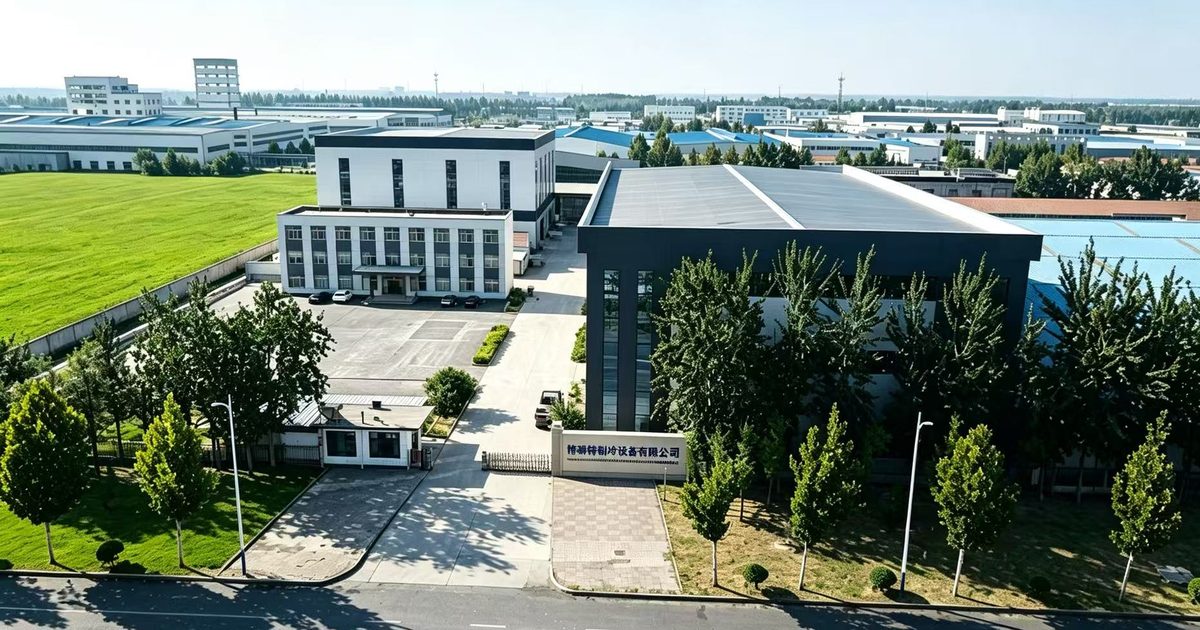
Orders placed from Boxing County, Binzhou, Shandong are built against the supply data confirmed at enquiry — panels and doors from our own workshop, with the refrigeration package, controls and installation drawings matched to the site supply rather than to a default export standard. If you are at the specification stage, send the site voltage, frequency and phase count together with the room temperatures and dimensions, and the reply can quote the correct machine the first time. Phone +86 15898896999 or email 3107900547@qq.com.
Send us the product, storage volume, target temperature and site conditions — our engineers will come back with a preliminary scheme and budget range within 24 hours.
Email us 15898896999