Condensing Unit Sizing for Cold Rooms: Why kW at Evaporating Temperature Matters
A cold room quotation that lists only "10 HP compressor" or "15 HP condensing unit" is not a sizing sheet. It is a guess dressed up as a specification.
The same condensing unit can deliver 18 kW at −10 °C evaporating temperature and only 10 kW at −30 °C evaporating temperature. The difference is not a small correction — it is the difference between a plant that holds temperature and a plant that runs flat out and never quite gets there. For a buyer, the only useful capacity figure is kW at a stated evaporating temperature, checked against the room's calculated heat load.
This article explains how to size a condensing unit for a cold room, what information the supplier actually needs, and the common shortcuts that make plants look cheaper on paper but cost more in electricity and callbacks.
1. What "condensing unit" means in a cold room project
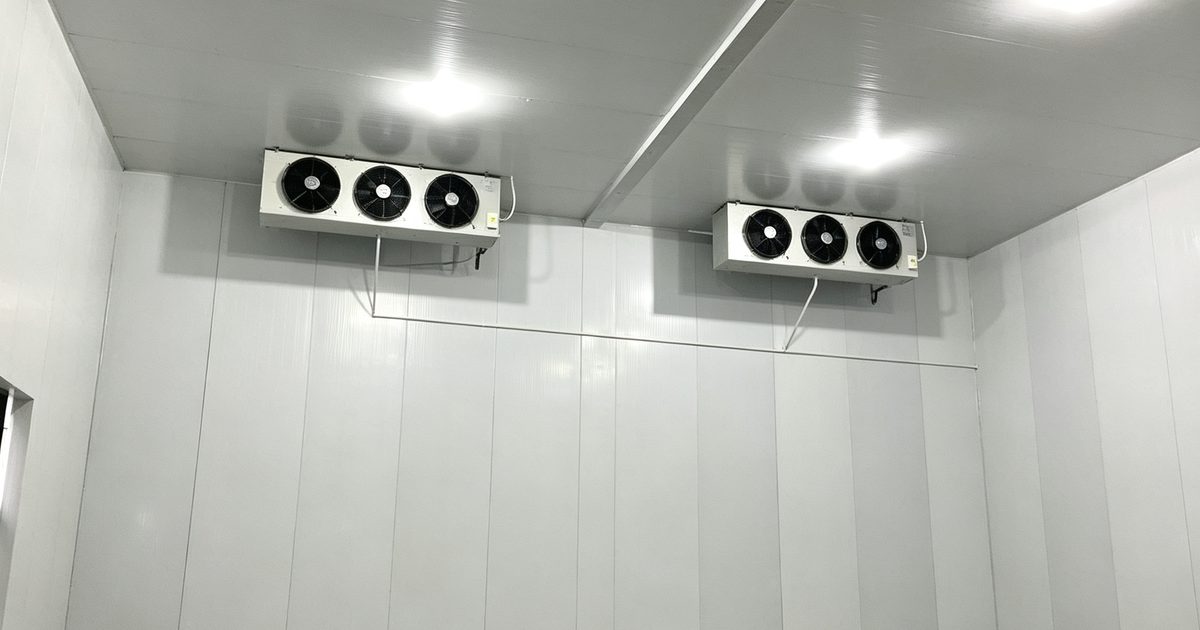
In most cold storage projects the condensing unit is the outdoor part of the refrigeration system: compressor, condenser, receiver, controls and sometimes an oil separator or subcooler. It connects to one or more evaporators inside the room through suction and liquid lines.
The unit's job is to remove heat from the room at a rate that matches the heat gain. Heat gain comes from:
- Product cooling load: bringing the stored product down to room temperature.
- Infiltration through doors, walls, ceiling and floor.
- Internal loads: lights, fans, forklifts, people, defrost heaters.
- Safety margin: typically 5–15 % on top of the calculated load for unexpected conditions.
A quotation that skips the load calculation and jumps straight to "X HP unit" is guessing. A properly sized unit starts with the calculated load and then selects the machine that delivers the required kW at the design evaporating temperature.
2. Why capacity must be quoted at evaporating temperature
Refrigeration capacity is not a single number. It depends on two temperatures:
- Evaporating temperature (also called suction temperature or saturated suction temperature): the boiling point of the refrigerant inside the evaporator.
- Condensing temperature: the temperature at which the refrigerant liquefies in the condenser, driven by ambient conditions.
Lower evaporating temperatures mean lower suction pressure and lower refrigerant mass flow. The same compressor therefore delivers less cooling capacity as the evaporating temperature falls. A unit chosen for a +2 °C chiller will be far too small if moved to a −25 °C freezer without being reselected.
| Evaporating temperature | Typical application | Capacity change on the same unit |
|---|---|---|
| +5 °C to +10 °C | Chill rooms, pre-cooling | Highest — the compressor moves more refrigerant per hour. |
| −5 °C to −10 °C | Fresh produce, dairy storage | 25–40 % lower than at +5 °C for the same compressor. |
| −20 °C to −25 °C | Frozen meat and seafood | 45–60 % lower than at +5 °C; unit must be selected here. |
| −30 °C to −40 °C | Blast freezers, IQF tunnels | 60–75 % lower; separate blast design, not room storage sizing. |
The table above is based on typical compressor performance curves and is intended as a rough guide. The final selection must use the manufacturer's exact data sheet for the refrigerant and operating conditions of the project.
Engineering tip: Always ask for capacity in kW at the evaporating temperature of your room, not just the compressor horsepower. A 15 HP compressor can be rated for −10 °C or −30 °C work, and the delivered kW is very different. If the supplier replies with only HP, ask again for the kW curve.
3. The numbers a supplier needs before selecting a unit
To size a condensing unit properly, an engineer needs more than room dimensions. The following inputs drive the heat load calculation:
| Input | Why it matters | What happens if it is missing |
|---|---|---|
| Room internal dimensions | Determines surface area, air volume and product mass. | Underestimated wall gain and poor air distribution. |
| Target temperature and daily variation | Sets evaporating temperature and safety margin. | Wrong evaporating temperature selection. |
| Ambient design temperature | Affects condenser sizing and condensing pressure. | High-ambient underperformance or head pressure trips. |
| Product in/out temperature and turnover | Product cooling is often the largest single load. | Unit cannot pull product down in time. |
| Daily door openings and duration | Infiltration load rises sharply with traffic. | Room temperature never settles. |
| Insulation thickness and core density | Determines wall and ceiling heat gain. | Thermal bridges cause condensation and energy waste. |
| Refrigerant preference or restriction | Some markets restrict certain refrigerants. | Delivery blocked by import or environmental rules. |
| Electrical supply | 380 V / 3 ph / 50 Hz is common in China; some sites need 60 Hz or special voltage. | Unit arrives incompatible with site power. |
If a supplier quotes without asking for these, the unit size is based on a rule of thumb, not on your project. Rule-of-thumb sizing sometimes works for standard rooms, but it fails for high-traffic rooms, tropical climates, thick product loads, or very low temperatures.
4. How to read a condensing unit quotation
When a quotation arrives, check these five points before comparing prices:
- Rated capacity in kW at the design evaporating temperature. If it only says HP, request a data sheet.
- Compressor type and refrigerant. Scroll compressors are quiet and efficient for small-to-medium rooms. Reciprocating compressors are robust and widely serviced. Screw compressors suit large plants and long running hours. Refrigerant choice must match the site temperature and local regulations.
- Condenser sizing for the ambient temperature. A condenser selected for 35 °C will struggle at 43 °C. Ask for the maximum design ambient.
- Control package. Simple on/off control is cheaper but less efficient than a system with electronic expansion valves, variable speed fans or capacity steps.
- Scope split. Is the quotation for the outdoor unit only, or does it include evaporators, piping, controls, installation and commissioning? Two quotations with different scopes are not price differences — they are different products.
Engineering tip: Ask the supplier to put the operating points on the quotation: evaporating temperature, condensing temperature, refrigerant, voltage, frequency and ambient design temperature. Those five lines turn a vague number into a comparable specification. If they are missing, every later argument about performance will be based on assumptions.
5. Common sizing mistakes and what they cost
The cheapest quotation is often the one with the smallest unit. That is also the one most likely to cause problems.
| Mistake | Why it happens | Typical consequence |
|---|---|---|
| Unit selected at −10 °C for a −25 °C room | Sales catalogue defaults to common conditions. | Room cannot reach set point; compressor runs continuously and fails early. |
| Ignoring infiltration from doors | Harder to estimate than wall gain. | Temperature swings, ice build-up, high energy use. |
| No allowance for product pulldown | Focus on steady-state storage only. | Product loaded warm cannot be cooled within safe time. |
| Condenser undersized for hot ambient | Lower condenser cost. | High discharge pressure, trips, poor efficiency in summer. |
| Single oversized unit for multi-room plant | Simpler design, lower first cost. | One failure loses all rooms; part-load efficiency suffers. |
An undersized unit does not just use more electricity. It shortens compressor life, causes frozen product losses and produces temperature records that fail audits. In pharmaceutical or food-export applications, that can mean rejected batches.
6. Price indication and what drives it
Condensing unit price depends on compressor brand, refrigerant, control level, condenser size and included scope. A small packaged unit for a walk-in chiller may cost a few thousand US dollars; a heavy-duty low-temperature rack for a multi-room distribution centre can cost tens of thousands.
⚠️ Price ranges in any article are indicative. Replace the numbers below with your actual quotation before sharing them with a client.
| Application type | Approximate capacity range | Typical price indication (outdoor unit only, FOB China) |
|---|---|---|
| Walk-in cooler, +2 °C to +8 °C | 3–8 kW | ⚠️ replace with your actual quotation |
| Small freezer room, −18 °C to −20 °C | 5–12 kW | ⚠️ replace with your actual quotation |
| Medium cold storage, −20 °C to −25 °C | 10–25 kW | ⚠️ replace with your actual quotation |
| Blast freezer / low-temp room | 20 kW and above | ⚠️ replace with your actual quotation |
The total project cost also includes insulation panels, evaporators, cold room doors, controls, refrigeration piping, installation and commissioning. The condensing unit is usually 20–35 % of the total for a medium-sized cold room, but that share varies widely with temperature and local labour cost.
7. Compliance and site conditions: what to flag early
Before a unit is ordered, confirm the market rules and site conditions that cannot be changed later.
- Electrical supply: voltage, phase, frequency and maximum available current. A 50 Hz unit on a 60 Hz site will run fast, over-amp and void warranty.
- Refrigerant regulations: some countries restrict high-GWP refrigerants. R404A, R507 and R22 are increasingly regulated; R448A, R449A, R452A and CO₂ options may be required for new projects.
- Noise and location: condensing units belong outside or in a plant room. Check neighbour distance, sound limits and ventilation.
- US market: if the project is in the United States, ask the supplier about UL/ETL listing, EPA SNAP refrigerant status and DOE minimum energy efficiency. Do not assume these are covered unless they are written into the quotation.
Engineering tip: Send the supplier a one-page site checklist before asking for a firm quotation. Include target temperature, ambient temperature, product load, door traffic, electrical supply and any refrigerant or certification restrictions. The replies you get back will be more accurate and much easier to compare.
8. When to ask for help from the manufacturer
If the project has any of the following, involve the manufacturer early rather than relying on a standard catalogue unit:
- Very low temperature (−30 °C or below).
- High ambient conditions (above 40 °C).
- Frequent door openings or multiple temperature zones.
- Strict temperature band requirements (pharmaceuticals, vaccines).
- Need for redundancy or future expansion.
- Local restrictions on refrigerant, voltage or certification.
A manufacturer with in-house panel production and project engineering can adjust panel thickness, unit capacity and control logic as one system rather than as separate boxes. That matters because the wall insulation and the refrigeration plant are not independent decisions: a thinner panel forces a larger unit, and a larger unit raises running cost for the life of the room.
How BRT approaches condensing unit sizing
At our workshop in Boxing County, Binzhou, Shandong, China, we build PU sandwich insulation panels and cold room doors and assemble complete cold storage projects. When we size a condensing unit, we ask for the room dimensions, product load, door traffic and site climate first, then match the unit capacity to the actual heat load.
We do not use catalogue HP as a substitute for calculation. Every quotation we issue lists the required capacity in kW at the design evaporating temperature, plus compressor type, refrigerant and electrical supply. If you already have a quotation and want a second check, send it over and we will look at the operating points.
For a preliminary scheme and budget range, email us the room target temperature, dimensions and product turnover, or call +86 15898896999.
Send us the product, storage volume, target temperature and site conditions — our engineers will come back with a preliminary scheme and budget range within 24 hours.
Email us 15898896999