Ammonia vs CO2 vs Fluorinated Refrigeration: Choosing a Cold Storage Plant System
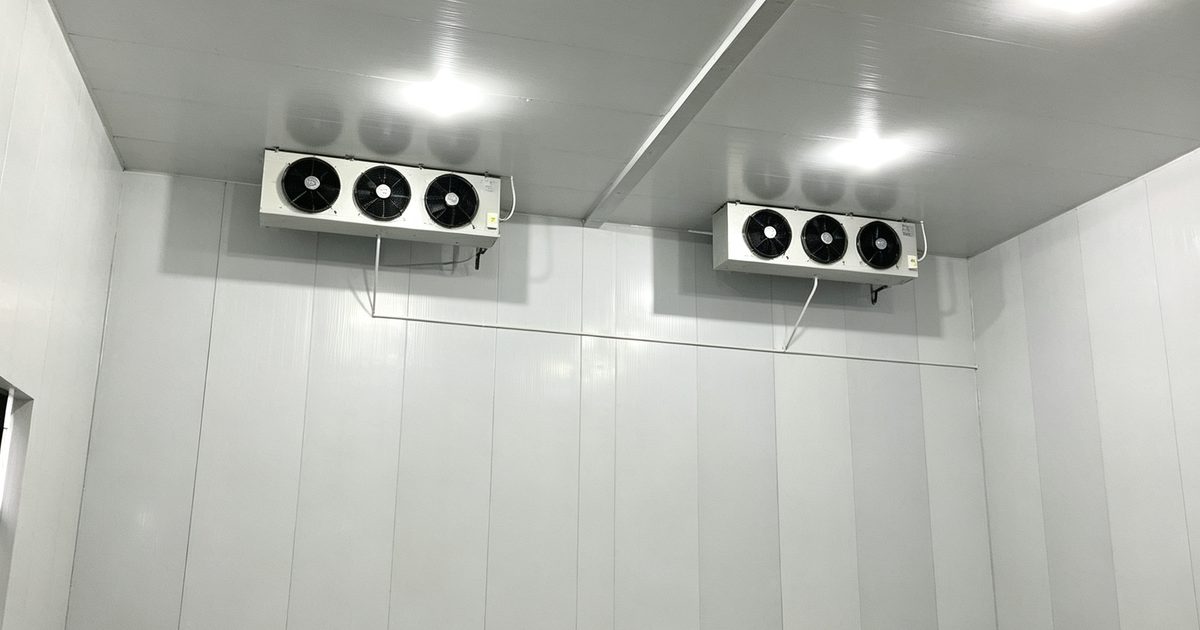
Most articles about refrigerant choice compare gases: GWP numbers, phase-down schedules, prices per kilogram. That matters for packaged equipment, but for a medium or large cold store the real decision is bigger than the gas. What you are actually choosing is a plant architecture — machinery room versus roof-mounted packages, the size of the refrigerant charge, the safety regime around it, and the skills your local service market must have for the next twenty years.
⚠️ All capacity ranges, charge figures, efficiency numbers and cost indices below are industry-typical reference values for planning discussion only. Final values must be calculated for your actual load, climate, grid and safety code. Every price must be replaced with your actual quotation.
Three architectures, not three gases
Before comparing properties, be clear about what each option physically is:
- Ammonia (R717) central plant. Screw or reciprocating compressors in a machinery room, evaporators (or a secondary coolant — glycol, or pumped CO2) inside the rooms, condensers on the roof. Low pressure, excellent efficiency.
- CO2 (R744) cascade system. CO2 circulates inside the rooms; a top stage — ammonia or a fluorinated refrigerant — rejects the heat through a cascade heat exchanger.
- Fluorinated DX (direct expansion) systems. Condensing units or racks on R448A/R449A, R507, R407 series or R290, with DX evaporators in the rooms. Familiar technology, modular, simple to service.
The table puts the three side by side for a plant roughly in the 200–5,000 m³ class. Below that size, packaged fluorinated equipment almost always wins on simplicity; above it, ammonia and CO2 cascade become increasingly hard to argue against.
| Property | Ammonia central plant | CO2 cascade (NH3 or HFC top stage) | Fluorinated DX / rack |
|---|---|---|---|
| Typical economical scale | ≳ 500 m³ or multi-room sites | 200–10,000 m³, one to many rooms | Below ≈ 1,000 m³, modular sites |
| Safety class (ISO 5149 / ASHRAE 34 style) | B2L — toxic, low flammability | A1 (CO2 side), high pressure | Mostly A1; R290 is A3 |
| Typical charge per 100 kW plant | Largest of the three | CO2 side moderate; top stage small | Moderate |
| Efficiency at freezer duty | Best available | Very good at the CO2 stage | Good, falls behind at −25 °C and below |
| Machinery location | Dedicated machinery room, normally required | Plant room or roof, package-dependent | Roof / wall packages, no machinery room |
| Local service skills needed | Ammonia-qualified engineers — often scarce | Moderate; CO2 high-pressure discipline | Widely available everywhere |
| Regulations driving design | Toxic-gas machinery room, ventilation, detection | High-pressure vessels and piping (≈ 40–120 bar) | F-gas style quotas and records |
| Relative plant cost index | 1.6–2.2 | 1.3–1.8 | 1.0 (baseline) |
The cost index only counts the refrigeration plant itself. Once machinery room construction, safety systems and lifetime energy enter the comparison, the ranking frequently changes — which is why the decision must be made on total cost over the plant's life, not on the quotation total.
Ammonia: efficiency and maturity, with a safety price
Ammonia has been the refrigerant of industrial refrigeration for a century, and nothing has displaced it on thermodynamics. It has zero ozone depletion potential and zero GWP, superior heat-transfer properties, and compressor manufacturers still build dedicated NH3 ranges for exactly this duty. On a freezer plant, ammonia is typically the most efficient option on the table — the gap against a halocarbon DX plant is usually worth 10–20 % on plant energy, which over twenty years often outweighs a higher initial cost.
The price is the safety envelope. Ammonia is toxic (safety class B2L), so codes typically require a dedicated, ventilated machinery room with detection, alarm and emergency ventilation, and restrict charge inside occupied spaces. In practice this pushes the design toward keeping the ammonia inventory in one supervised room and serving the rooms with a secondary fluid — glycol, or increasingly pumped CO2. Two design trends matter to buyers:
- Charge minimisation. Modern plants hold a fraction of the charge of older designs — small receivers, low-charge evaporators, liquid-overfeed or DX coils instead of flooded surge drums. Ask what charge (kg of NH3 per kW of plant) the design targets; it is a direct proxy for how modern the architecture is.
- NH3/CO2 cascade. Ammonia stays in the machinery room as the top stage; CO2 does the room-side work. This keeps ammonia benefits while removing it from the occupied building — currently the fastest-growing architecture for mid-size industrial cold stores.
Engineering tip: Do not compare catalogue efficiency at one operating point. Ask each bidder for the plant annual energy consumption (kWh/year) at your actual load profile, including evaporator fans, defrost energy and secondary-fluid pumps. Ammonia plants frequently win the lifetime comparison on the secondary losses alone.
CO2 cascade: the middle path for mid-size cold stores
In a subcritical cascade, CO2 circulates between the room evaporators and a cascade heat exchanger, staying below its critical point, while the top stage (ammonia or a fluorinated refrigerant) lifts the heat to ambient. This is the standard architecture for mid-size cold storage today, because it combines three useful properties:
- A1 safety class on the room side. No machinery room is demanded for the CO2 circuit itself, and charge inside food areas is acceptable.
- Excellent heat transfer and compact equipment. CO2's high working pressure produces small, light evaporators and pipes — cheaper to install, less refrigerant in circulation.
- A small top-stage inventory. Only the top stage contains the regulated or toxic refrigerant, and that charge is a fraction of an equivalent all-halocarbon plant.
The costs are discipline and pressure. CO2 systems work at roughly 30–40 bar on the suction side and well above 100 bar in design conditions, so every vessel, valve and joint must be certified for the pressure class, and technicians must be trained for high-pressure work — industrial refrigeration practice, not general air-conditioning. Transcritical CO2 dominates in supermarket heat-recovery applications, but for pure cold storage duty at −18 °C and below, the subcritical cascade is nearly always the more practical choice.
Where CO2 cascade is the clear answer: single-building cold stores in the 200–5,000 m³ range, sites without an ammonia-qualified service market within reach, food-grade facilities where toxicity in occupied spaces is unacceptable, and any project where the authority having jurisdiction resists ammonia near occupied areas.
Fluorinated DX: simple, modular, and still right at small scale
The fluorinated option — condensing units and racks on R448A/R449A, R507, R407 variants or R290 — should not be dismissed by reflex. Its weaknesses are known: GWP and the phase-down schedules that squeeze high-GWP refrigerants (covered in our earlier article on the R404A phase-down), efficiency that falls behind ammonia at deep-freeze duty, and refrigerant price exposure. Its strengths are equally real: the entire industry knows how to install and service it, spare parts are on every distributor's shelf, no machinery room is required, and the plant can grow module by module as your business does.
For a buyer, the honest summary is this: below roughly 1,000 m³ of room volume, a fluorinated packaged system usually has the lowest total cost of ownership once installation, commissioning and local service reality are counted. In the 1,000–2,000 m³ band, the comparison becomes genuinely case-by-case and should be run on annual kWh, not quotation totals. Above that, DX plants still get built — particularly where phased expansion matters — but the energy gap against NH3 or NH3/CO2 becomes difficult to defend over a twenty-year horizon.
Two fluorinated-side points worth checking in any quotation:
- Refrigerant availability at destination. A refrigerant that is cheap in China may be quota-limited, expensive or serviced by a single importer in your market. Confirm local supply before accepting the refrigerant in the contract.
- Refrigerant in the contract. Specify whether first charge ships with the equipment, and who owns the compliance documentation (F-gas or SNAP-style records) at import. Miss this and a shipment can sit in customs over a paperwork gap.
Engineering tip: Whatever architecture you buy, ask the supplier to state the total design refrigerant charge broken down by circuit. The charge number is not trivia: it determines your safety regime (many codes tier requirements by charge mass), your leak-checking obligations, the size of the emergency ventilation system, and the cost of a top-up. A supplier who cannot state the charge has not actually designed the plant.
The decision, reduced to a table
Every project argues its own case, but the starting position for most buyers is predictable:
| Your situation | Sensible starting architecture |
|---|---|
| Below ≈ 1,000 m³, few rooms, local service market is general refrigeration | Fluorinated DX condensing units |
| 200–5,000 m³ food-grade store, no ammonia skills nearby | CO2 cascade with fluorinated top stage |
| 200–5,000 m³, authority restricts ammonia in occupied areas | NH3/CO2 cascade — ammonia confined to the machinery room |
| Multi-room site ≳ 500 m³ with planned expansion, ammonia technicians available | Ammonia central plant, low-charge design |
| Freezer duty below −25 °C, energy cost dominates the business case | Ammonia plant (or NH3/CO2 cascade) on lifecycle economics |
| Phased build-out, uncertain growth | Fluorinated DX racks now, architecture reviewed at each phase |
Treat these as opening positions to hand your engineering contractor, not conclusions. The decisive inputs — local safety code, electricity tariff, service skills actually available in your region, and your expansion plan — are things only you can supply.
What this changes for an importer or project owner
The architecture decision reaches further than the plant. Before you commit, settle four practical questions:
- Who services it at 3 a.m.? Ammonia and CO2 both demand technicians with specific training and certifications. If nobody in your region holds them, that fact should veto the architecture — not the catalogue efficiency.
- What ships in the container? An ammonia plant ships as components for on-site assembly; a CO2 cascade ships as engineered packages with pressure-certified piping; fluorinated racks ship nearly complete. Installation duration, crane requirements and labour skill follow from this.
- What does the safety file require? Ask in writing what documentation the plant needs at import and commissioning: pressure vessel certificates, piping test records, charge declarations, detection and ventilation schematics, operator training.
- What are the spares? Compressor spares, safety valves, CO2 pressure-rated components and ammonia-specific fittings are not interchangeable between architectures. Order the plant-specific spares list with the equipment — the freight economics of a box in the container versus an emergency air shipment were covered in our spare parts article.
Questions to put in the RFQ
To compare bids across architectures on a like-for-like basis, require every bidder to answer:
- Proposed architecture, refrigerants and total design charge per circuit (kg);
- Plant capacity (kW) stated at your evaporating temperature and ambient, not at a nominal rating point;
- Estimated annual energy consumption (kWh/year) at your load profile, including fans, defrost and pumps;
- Machinery room, detection and ventilation requirements your design assumes, by code citation;
- Pressure class and certification of CO2 components, where applicable;
- Commissioning scope, operator training and the plant-specific spare parts list;
- Local service arrangement for the refrigerant proposed — who, where, with what certification.
In summary
The refrigerant is the visible part of the decision; the architecture is the part that costs money for twenty years. Ammonia buys the best efficiency at the price of the heaviest safety and skills requirement; CO2 cascade buys an A1 room side and compact equipment at the price of high-pressure discipline; fluorinated DX buys simplicity and a service market that exists everywhere, at the price of efficiency and refrigerant-policy exposure at deep-freeze duty. Match the architecture to your scale, your safety code, your tariff and your local service reality — and make every bidder prove their numbers on the same assumptions page before you sign anything.
Shandong Boruite Refrigeration Equipment Co., Ltd. builds refrigeration plants for cold storage projects — packaged condensing units, PU insulation panels and cold room doors manufactured in our own workshop in Boxing County, Binzhou, Shandong, China — with design, equipment supply, installation guidance and after-sales service for overseas buyers. To discuss which architecture fits your project, contact us at +86 15898896999 or 3107900547@qq.com; final equipment selection is always calculated against your actual load, climate and safety code.
Send us the product, storage volume, target temperature and site conditions — our engineers will come back with a preliminary scheme and budget range within 24 hours.
Email us 15898896999