Cold Room Defrost Methods Compared: Electric, Water and Hot Gas
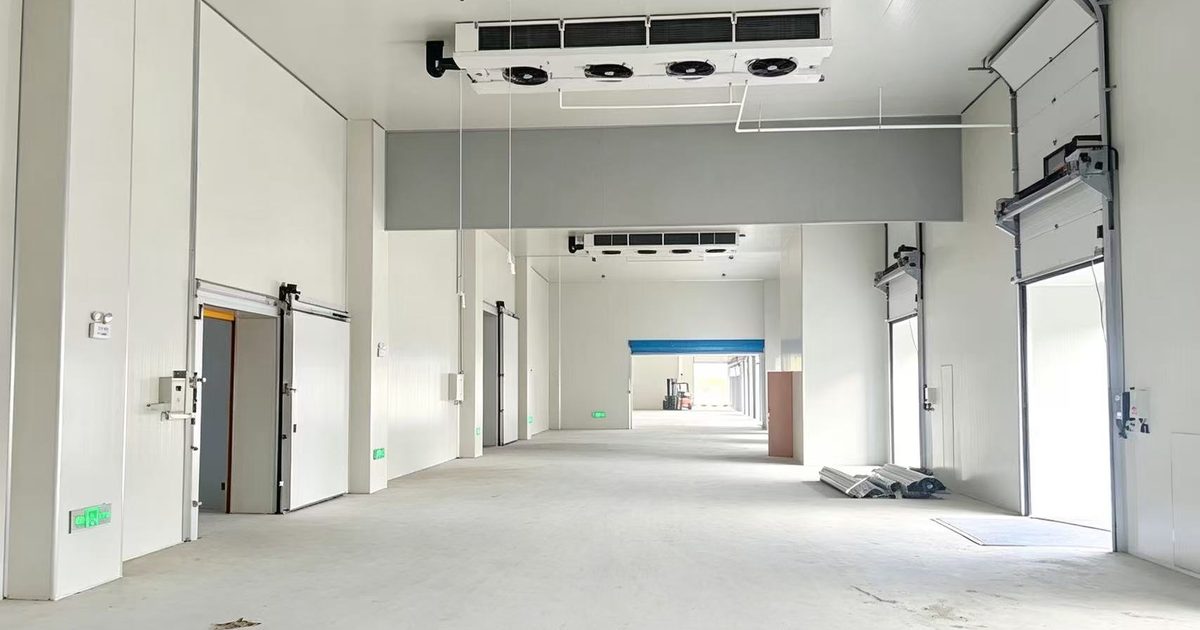
Frost on an evaporator is insulation. As it builds, airflow drops, heat transfer falls, the room struggles to hold temperature, and the plant runs longer for less cooling. Defrosting is therefore not an accessory — it is part of how the room performs.
But defrosting also costs energy: every joule put in to melt frost has to be taken back out by the refrigeration system afterwards. The method you choose decides how much that costs, every day, for the life of the room.
Why frost forms, and when it matters
Moisture in the room air freezes onto any surface below 0 °C — principally the evaporator coil, which is the coldest thing in the room. Moisture comes from three places: the product itself, warm humid air entering through open doors, and air brought in with incoming goods.
How fast frost builds depends mainly on room temperature and product type. A dry goods chilled room may need defrosting once a day or less. A −18 °C room handling unpackaged fish or wet product can need it twice a day. A high-humidity fresh produce room sits somewhere in between.
The right trigger is not the clock alone. Defrost when the coil is actually frosted — a time schedule plus a coil temperature check gives better results than either alone.
The three methods
Electric defrost
Heater elements are inserted into or mounted against the evaporator coil and switched on to melt the frost.
- Capital cost: lowest. Simple to install, simple to control, easy to retrofit.
- Running cost: highest. All the heat is added from outside the system and must then be pumped back out.
- Speed: slow — typically 30 to 60 minutes per cycle.
- Temperature swing: largest, because the heaters keep adding heat after the frost has gone.
- Watch for: elements burning out. Undersized elements lead to incomplete defrost, residual frost accumulates, and the coil progressively chokes.
- Best for: small to medium rooms, chilled and fresh storage rooms, low defrost frequency.
Water defrost
Water is sprayed over the coil; the heat in the water melts the frost.
- Capital cost: moderate — needs a water supply, distribution pipework, and drainage.
- Running cost: low. Far less energy than electric, and defrost is over quickly.
- Speed: fast — often 15 to 25 minutes.
- Temperature swing: moderate.
- Watch for: drainage. Melt water has to leave the room reliably, and in a frozen room the drain line will freeze solid unless it is trace-heated. Water splashing onto the floor or product is the other risk.
- Best for: −18 °C and below, blast freezers, high frost loads.
Hot gas defrost
Hot high-pressure discharge gas from the compressor is routed into the evaporator, melting the frost from inside the coil outwards.
- Capital cost: highest — requires dedicated piping and a valve set (four-way valve or a bypass arrangement), and it has to be designed properly.
- Running cost: lowest. The heat is already in the system, and melting from inside out is efficient.
- Speed: moderate — usually 20 to 40 minutes.
- Temperature swing: smallest, which matters for temperature-sensitive product.
- Watch for: design quality. Poorly designed hot-gas systems can cause liquid flood-back to the compressor. This is not a "fit an extra solenoid valve" job.
- Best for: large rooms, continuous-operation sites, long-run frozen storage where energy cost dominates.
Side-by-side
| Electric | Water | Hot gas | |
|---|---|---|---|
| Capital cost | Low | Medium | High |
| Energy per defrost | High | Low | Lowest |
| Defrost duration | 30–60 min | 15–25 min | 20–40 min |
| Room temperature swing | Largest | Moderate | Smallest |
| Maintenance | Element replacement | Drain and trace heating | Valve set |
| Typical application | Chilled / fresh, small–medium | −18 °C and below, blast freezers | Large rooms, continuous duty |
Starting settings by room temperature
When a new plant is commissioned there is no history to work from, so start from the following table and tighten the cycle after three days of observation.
| Room temperature | Suggested method | Starting interval | Termination set point | Notes |
|---|---|---|---|---|
| 0 to +10 °C | Electric, or off-cycle defrost | Every 8–12 h | Coil 8–10 °C | Frosting is slow; err on the side of defrosting less |
| −2 to 0 °C | Electric | Every 6–8 h | Coil 8–10 °C | Shorten to 6 h with high humidity or heavy door traffic |
| −10 to −18 °C | Water or hot gas | Every 4–6 h | Coil 10–12 °C | Drain trace heating is mandatory |
| Below −18 °C | Water or hot gas | Every 3–4 h | Coil 12–15 °C | Consider triggering on coil pressure drop instead of the clock |
Engineering tip: set the interval long to begin with and shorten it only if frost actually remains. Every unnecessary defrost puts heat into the room that the plant then has to remove again, so an over-frequent cycle costs twice — once heating, once cooling — and adds temperature swing on top.
A rough sense of the numbers: on a −18 °C room defrosting twice daily with electric heaters, defrost can account for a noticeable share — sometimes 10–20% — of total room energy. Moving that same room to water or hot gas defrost often pays back the extra capital within two or three years.
Four mistakes that undermine any of the three
1. No drain trace heating. A defrost drain in a frozen room without a heater cable will freeze. It always does, usually in the first winter, and clearing it means stopping the room and thawing the line. Budget for trace heating from the start.
2. No drip delay before the fan restarts. When heating stops, water is still hanging on the coil. Starting the evaporator fan immediately blows that water into the room, where it lands on product and floor and refreezes. A 3–5 minute drip delay after heating, before the fan restarts, prevents this.
3. Defrost sensor in the wrong place. Termination is usually triggered by coil temperature. If the sensor sits close to a heater or in a spot that warms quickly, defrost ends early and frost remains — the coil then ices up a little more each cycle until performance collapses. The sensor belongs at the point that defrosts last, typically the outer edge or the lower return side of the coil.
4. Fixed cycle never revisited. Frost load changes with season, product and door traffic. A cycle set once and never reviewed either wastes energy in quiet periods or under-defrosts in peak season. Revisit it seasonally, or use coil-temperature termination.
Engineering tip: the drain line tells you almost everything about whether frost has actually melted. Water should start flowing roughly five minutes into the defrost cycle. Less than two minutes of flow usually means the outer frost never melted; no flow at all points to a frozen drain, or to a cycle that was unnecessary in the first place.
What retrofitting is actually worth
Converting an existing electric defrost to water or hot gas is one of the shorter paybacks available in cold room retrofit, but it is not automatic. Work out what defrost costs today before quoting anything: heater load in kW × hours per cycle × cycles per day × operating days per year gives the annual defrost energy in kWh. Multiply by the local tariff and you have the visible cost — then allow another 30–50% on top, because that heat has to be pumped back out by the plant.
For scale: a −18 °C room with 9 kW of heaters, defrosting twice a day for 40 minutes, uses roughly 4,300 kWh a year on defrost, which at USD 0.10/kWh is a little over USD 400 before the re-cooling penalty. Water defrost typically cuts the defrost energy to around a tenth; against pump power and water charges that leaves a few hundred dollars a year saved, and paybacks of two to three years are common where rooms run most of the year.
Engineering tip: before any conversion, spend two weeks logging just three things — defrost cycles per day, suction and discharge pressure, and daily kWh. That baseline turns the retrofit proposal from a sales estimate into something you can check afterwards, and occasionally shows the money is better spent on door seals or panel joints instead.
The reverse case is worth stating plainly: a seasonal room that runs three months a year, or a chilled room that barely frosts, rarely justifies the conversion. On those rooms the same money usually returns faster through better door seals, a strip curtain, or simply cleaning the coil and condenser. Match the spending to the running hours, not to the technology.
Choosing for your room
- Chilled rooms above 0 °C: electric defrost is usually sufficient. Focus on getting the cycle right rather than on the hardware.
- −18 °C frozen storage: water defrost is the sensible default; hot gas if capital allows and running hours are high.
- Blast freezers and high frost loads: water or hot gas. Electric is generally not suitable.
- Large multi-temperature sites: hot gas with zone control gives the lowest long-run cost.
If a room has slowly become more expensive to run and slower to pull down, the defrost system is one of the first places to look. Send us the room temperature, evaporator model, defrost method and cycle settings and we will tell you whether incomplete defrost is likely to be the cause.
Send us the product, storage volume, target temperature and site conditions — our engineers will come back with a preliminary scheme and budget range within 24 hours.
Email us 15898896999