Cold Room Energy Consumption: How to Estimate kWh and Running Cost Before You Buy
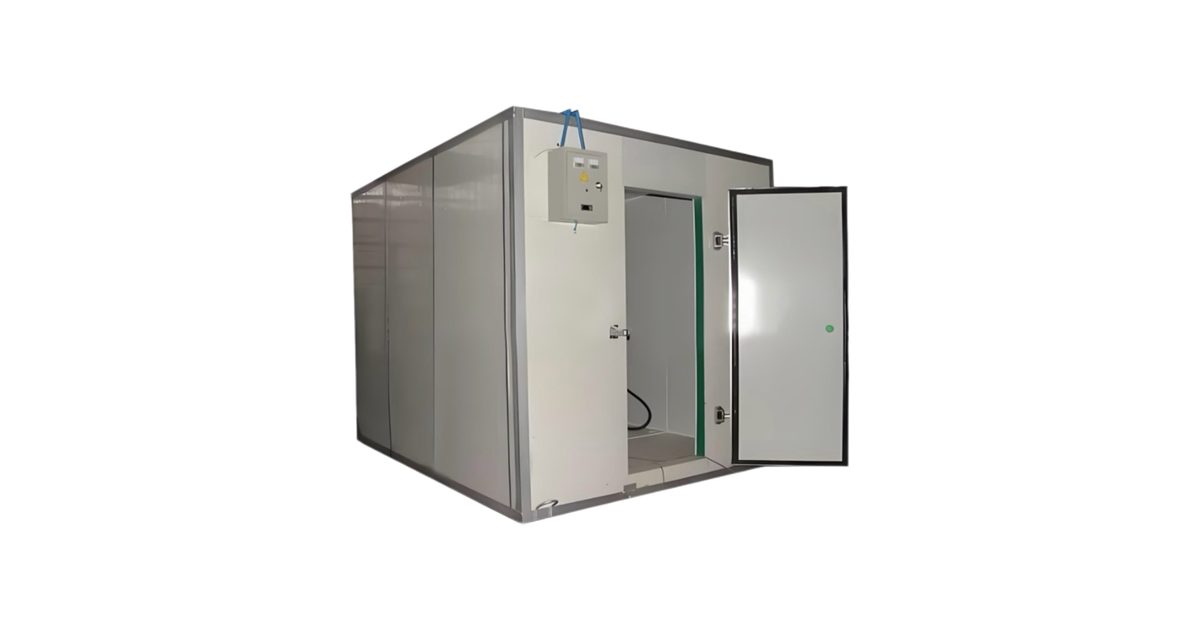
Buyers compare cold rooms on purchase price because it is the number on the quotation. But over ten years, electricity usually costs more than the equipment did — and the gap between a well-matched system and a poorly matched one is often thirty to fifty percent of the annual bill.
The problem is that suppliers rarely quote running cost, and the few who do often quote a theoretical figure calculated at conditions your site will never see. This article gives a way to estimate it yourself, well enough to compare two quotations and to tell whether a design is sensible.
Where the energy actually goes
A cold room's electricity use comes from four places, and only one of them is "the cold".
| Load component | Typical share of total | What drives it up |
|---|---|---|
| Heat transmission through panels, floor and door | 20–35% | Thin insulation, poor vapour sealing, direct sun on the roof |
| Product load (cooling incoming goods, freezing, respiration) | 25–45% | High throughput, warm incoming product, high water content |
| Internal loads (fans, lights, people, forklifts) | 10–25% | Undersized evaporator fans running continuously, lights left on |
| Refrigeration plant inefficiency | — | Low evaporating temperature, high condensing temperature, dirty coils |
The fourth item is not an independent load: it is a multiplier on the first three. A system running at a lower evaporating temperature than necessary, or rejecting heat at a high condensing temperature, uses noticeably more kWh for the same tonnage of cooling.
Engineering tip: The single most useful number on a quotation is the design evaporating temperature, not the room temperature. A room specified at -20°C designed for a -30°C evaporating temperature will use substantially more power than the same room designed for -25°C, because compressor capacity and efficiency both fall as evaporating temperature drops.
A workable estimate in six steps
You do not need to build a full load model to get a useful number. This sequence gets you within roughly twenty percent, which is enough to compare options.
Step 1 — Panel transmission load. Heat flow through a panel is area × U-value × temperature difference. For 100 mm polyurethane at a typical 40 kg/m³ density, a commonly used U-value is around 0.22 W/m²K; at 150 mm it falls to roughly 0.15. Multiply by the total exposed surface area (including floor and ceiling, which are often forgotten) and by the difference between ambient and room temperature.
Step 2 — Product load. Two cases: cooling goods down, or freezing them. Cooling uses mass × specific heat × temperature drop. Freezing adds latent heat, which for water-rich products is large — freezing 1 kg of water from 0°C to -18°C takes roughly the same energy as cooling about 7 kg of water by 10°C. Divide by the number of hours you allow for the pull-down to get kW.
Step 3 — Respiration load for fresh produce. Fruits and vegetables keep generating heat after harvest. Values vary widely by product and temperature; leafy vegetables are high, root crops and apples are low. If you are storing fresh produce, this is not a rounding error.
Step 4 — Internal loads. Evaporator fan motors run whenever the room needs cooling, plus defrost cycles. Lights are usually small. People and forklift traffic matter mostly in high-throughput distribution rooms with doors open often.
Step 5 — Infiltration. Every door opening lets warm humid air in. In a busy dispatch room this can rival the transmission load; in a long-term storage room opened twice a day it is negligible. Strip curtains, airlocks and door closers are cheap compared with the energy they save.
Step 6 — Convert kW to kWh and to money. Multiply the total kW by running hours. Note that the compressor does not run continuously: divide by a run-time factor, typically 0.5 to 0.8 depending on how well matched the plant is and how hot the climate is. Then multiply by your tariff, and check whether your tariff varies by time of day.
| Room type | Rule-of-thumb annual consumption | Main lever to reduce it |
|---|---|---|
| Small cold room, 20–50 m³, +2°C | 15–40 kWh per m³ of room volume per year | Door management, thicker panels |
| Medium cold room, 100–300 m³, +2°C | 10–25 kWh per m³ per year | Efficient fans, night setback where product allows |
| Freezer room, 100–300 m³, -20°C | 30–70 kWh per m³ per year | Evaporating temperature, defrost strategy, strip curtains |
| High-throughput dispatch room | Heavily dependent on door openings | Airlock, rapid doors, dock seals |
These are planning figures for a temperate climate with reasonable insulation, not guarantees. Hot climates, high throughput and thin panels push the numbers up.
Engineering tip: Ask for the estimate broken out by component, not just a single kWh figure. When a supplier shows you transmission, product and internal loads separately, you can see which assumption is doing the work — and you can compare two quotations on the same basis instead of comparing two different sets of assumptions.
Four things that move the bill more than the equipment choice
Condensing temperature. An air-cooled condenser in a 40°C summer rejects heat at a much higher temperature than the same unit at 25°C, and compressor power rises accordingly. Provide shade, clearance and ventilation. In consistently hot climates, evaporative condensers or water-cooled units can be worth the extra plumbing and water cost.
Defrost method and frequency. Electric defrost is simple and reliable but puts heat into the room that the plant then has to remove again. Hot gas defrost recovers much of that energy. Water defrost is fast and cheap to install but uses water and needs drainage. Defrosting more often than the frost load requires is pure waste — many rooms run fixed schedules nobody has revisited since commissioning.
Fan operation. Evaporator fans that run continuously consume power and add heat to the room. Cycling fans with the thermostat saves both, at the cost of slightly less even temperatures. For storage rooms this is usually a good trade; for rooms with tight temperature tolerances, weigh it carefully.
Door discipline and seals. Worn gaskets, a door left propped open, a missing strip curtain. None of these appear in a load calculation, and all of them show up on the bill. Frame heaters on freezer doors should be correctly sized: too small and ice builds up and prevents sealing, too large and they heat the room.
How insulation thickness and climate change the numbers
Panel thickness is usually chosen for first cost or for a target U-value in a specification. It also has a direct effect on running hours. The table below shows the planning U-value range for common PU sandwich panel thicknesses and the approximate effect on transmission load in a temperate climate. Thicker panels cost more up front, but they reduce compressor run hours every day for the life of the room.
| PU panel thickness | Typical U-value range | Relative transmission load at +2°C room | Relative transmission load at -20°C room |
|---|---|---|---|
| 80 mm | 0.28–0.32 W/m²K | 100% (baseline) | 100% (baseline) |
| 100 mm | 0.21–0.25 W/m²K | 75–80% of baseline | 75–80% of baseline |
| 120 mm | 0.18–0.21 W/m²K | 60–70% of baseline | 60–70% of baseline |
| 150 mm | 0.14–0.17 W/m²K | 45–55% of baseline | 45–55% of baseline |
| 200 mm | 0.11–0.13 W/m²K | 35–40% of baseline | 35–40% of baseline |
The percentage improvement is similar at chilled and frozen temperatures because both cases reduce heat inflow through the envelope. The absolute saving is larger for freezer rooms because the temperature difference across the panel is greater, so each watt of heat inflow removed saves more compressor power.
Climate has the opposite effect. A room in a 35°C summer rejects heat at a high condensing temperature and runs longer. The same room in a 25°C summer may use twenty to thirty percent less electricity. This is why a supplier's standard kWh figure from a cool climate is not reliable for a hot climate, and why shading and ventilation around the condenser are not afterthoughts.
Engineering tip: When you ask for a quotation, give the supplier your summer design ambient temperature and your expected daily throughput. A load calculation built on a 25°C ambient when your site sees 40°C will understate real consumption by a wide margin. Make sure the estimate is built on the same assumptions you will actually live with.
How to compare two quotations on running cost
Ask both suppliers for the same four numbers, in writing:
- Design evaporating temperature and the room temperature it is meant to hold
- Design condensing temperature assumed, and the ambient it is based on
- Compressor power input in kW at those conditions, not just cooling capacity
- Daily kWh estimate at a stated ambient and throughput
Then apply the same tariff and the same run-time factor to both. Two quotations that look close on price can differ by a wide margin on power input once you read item three.
Engineering tip: Check whether the quoted cooling capacity is stated at the design conditions or at a standard rating point. Capacity figures quoted at a warmer rating condition look larger and are not comparable with figures quoted at your actual evaporating temperature. This is one of the most common reasons a "bigger" unit performs worse on site.
What about night setback and variable speed?
Raising the set point a few degrees overnight saves energy, but only if the product tolerates it and only if the room has enough thermal mass for the saving to be real rather than just shifting the load into the morning pull-down. For chilled produce rooms with tight tolerances, the risk usually outweighs the saving.
Variable speed drives on compressors and fans pay back well where the load varies a lot through the day — high-throughput rooms, seasonal produce. In a steady long-term storage room with a constant load, the payback is much longer.
Summary
Estimate running cost before you buy, not after. Six steps get you close enough to compare designs; four numbers from each supplier let you compare quotations honestly; and the biggest savings usually come from condensing conditions, defrost strategy and door discipline rather than from choosing a different brand of unit.
*Prepared by the BRT Engineering Team. Figures are planning estimates for comparison purposes; actual consumption depends on climate, insulation, throughput and operating practice.*
Send us the product, storage volume, target temperature and site conditions — our engineers will come back with a preliminary scheme and budget range within 24 hours.
Email us 15898896999