Cold Room Evaporator Selection: Fin Spacing, TD and Capacity Correction
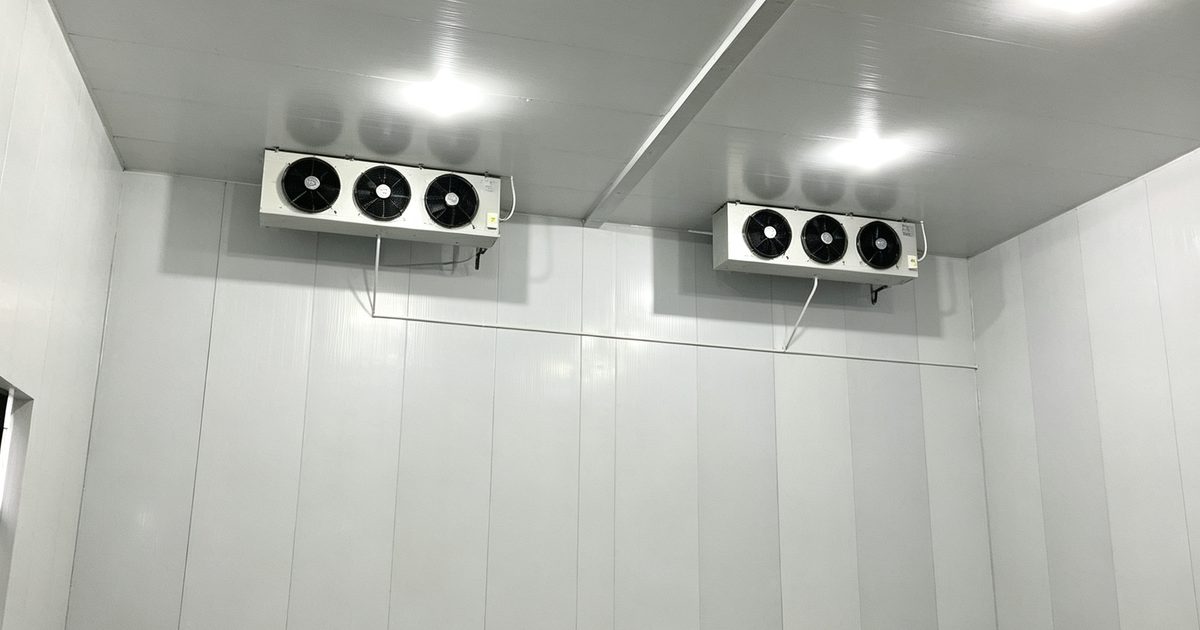
Most of the specification conversation in a cold room project goes to the condensing unit outside. The evaporator — the unit cooler hanging inside the room — gets a line in the quotation and little scrutiny. That is backwards. The evaporator is the component the product actually touches, thermally speaking, and it decides three things at once: how much heat is removed at a given temperature difference, how the air moves through the room, and how much moisture is pulled out of your goods.
When an evaporator is chosen badly, the symptoms rarely point at the evaporator. The room pulls down slowly, so the compressor looks undersized. Cartons near the unit dry out. The floor has ice on it in a freezer room. Defrost runs every four hours and the room never recovers. Almost all of these are coil selection problems, not refrigeration capacity problems.
This guide covers the numbers that decide a correct selection and the ones a supplier should be made to state in writing.
Three jobs, one box
A unit cooler is a heat exchanger with fans, a drain pan and a defrost system. It performs three separate functions, and they are optimised against each other.
| Function | What controls it | What goes wrong when it is underdone |
|---|---|---|
| Heat transfer | Coil surface area, fin spacing, refrigerant feed, TD | Room cannot reach set point, compressor runs continuously |
| Air distribution | Fan volume, throw, unit position | Warm and cold zones, door area never holds temperature |
| Moisture management | TD, fin spacing, defrost cycle, drain | Product dehydration, ice on floor, coil iced solid |
A coil selected only on catalogue kW satisfies the first and ignores the other two. That is the most common failure pattern in imported cold room kits.
TD is the number that sets everything else
TD is the difference between room air temperature and evaporating temperature. A chilled room held at 0 °C with refrigerant evaporating at −8 °C runs at a TD of 8 K.
TD is a design decision, not a consequence. For the same cooling duty, a higher TD lets you use a smaller, cheaper coil — and costs you relative humidity, because a colder coil condenses more water out of the air. For fresh meat, produce and anything sold by weight, that moisture is part of the product.
| Application | Room temperature | Typical TD | Typical RH outcome |
|---|---|---|---|
| Chill room, packaged / dry goods | 0 to +4 °C | 7 – 10 K | 75 – 85 % |
| Fresh meat, poultry hanging or boxed | −1 to +2 °C | 4 – 6 K | 85 – 90 % |
| Fruit and vegetable storage | 0 to +8 °C | 4 – 6 K | 88 – 95 % |
| Dairy and chilled distribution | +2 to +6 °C | 6 – 8 K | 80 – 88 % |
| Freezer storage | −18 to −22 °C | 6 – 10 K | Low, not controlled |
| Blast freezer / IQF tunnel | −30 to −40 °C | 10 – 15 K | Very low, by design |
These are industry reference ranges. The correct value for a specific room depends on product, packaging, air changes and local practice, and must be confirmed by calculation for that project.
⚠️ A quotation that states "12 kW evaporator" without evaporating temperature, TD and refrigerant is not a comparable offer. Two coils both called 12 kW can differ by 25 – 30 % in delivered duty at your actual room condition.
Engineering tip: force the quote onto one basis
Ask every supplier for evaporator capacity at your room temperature, your evaporating temperature and your refrigerant, in a single table. Catalogue ratings are usually published at a nominal TD such as 8 K or 10 K with one refrigerant. If one supplier quotes at nominal conditions and another at your conditions, the higher number is simply the one with the more favourable assumptions — it tells you nothing about the coil.
Fin spacing: surface area against frost and cleaning
Tighter fins mean more surface area per unit of coil face, which means more capacity per kilogram of aluminium. They also mean the coil blocks faster — with frost in a freezer, with dust and packaging fibre in a working store, and with washdown water in a food plant.
| Fin spacing | Best suited to | Defrost behaviour | Cleaning |
|---|---|---|---|
| 4.0 – 4.5 mm | Chilled rooms, low humidity, sealed packaged goods, low door traffic | Rarely needs defrost | Hard to clean; not for dusty or washdown rooms |
| 6.0 – 7.0 mm | General chilled storage, meat, dairy, vegetables | Moderate frost, electric defrost 1 – 2 times per day | Brush or low-pressure rinse |
| 7.0 – 9.0 mm | Freezer rooms with regular door openings | Heavy frost, electric defrost 2 – 4 times per day | Rinse accessible |
| 9.0 – 12.0 mm | Blast freezers, IQF, dusty environments, rooms with washdown | Very heavy frost, frequent defrost | Best cleanability |
Two rules of thumb hold up in practice. In a freezer room, going one fin-spacing step tighter usually buys less capacity than the frost it costs within a few weeks of operation. In a room where staff wash down floors and walls, a tight coil will be a maintenance item for its whole life.
Fin spacing also sets the defrost interval, and the defrost interval sets how much of the day the room actually refrigerates. A coil that ices up in three hours spends a meaningful share of its life in defrost, which is capacity you paid for and never receive.
Capacity correction: catalogue kW is not site kW
Every published duty is corrected for something. The corrections that matter when a coil arrives on a different continent from where it was rated are these:
| Correction factor | Effect on delivered capacity | Why |
|---|---|---|
| Refrigerant substitution (e.g. R448A / R449A for R404A) | −2 to −6 % | Different volumetric capacity and glide |
| TD lower than nominal rating point | Down roughly in proportion to TD | Capacity ≈ coil UA × TD |
| Frost build-up between defrosts | −5 to −15 % | Insulating layer, reduced air path |
| 60 Hz coil on 50 Hz supply | −10 to −17 % air volume, similar capacity loss | Fan speed and motor slip |
| Altitude above 1,000 m | −2 to −5 % | Lower air density, less mass flow |
| Long refrigerant lines / undersized distributor | −3 to −10 % | Pressure drop, uneven feed |
| Glycol or brine secondary loop | −8 to −20 % | Higher operating temperature difference needed |
For an export buyer, the frequency point deserves particular attention. A unit rated in a 60 Hz market and installed on a 50 Hz supply runs its fans slower: airflow drops roughly in proportion to frequency, and coil capacity falls with it. The compressor may be perfectly sized while the room still never pulls down. If the supply is 50 Hz, the coil must be selected at 50 Hz — not derated afterwards on paper.
Engineering tip: separate sensible capacity from total capacity
For chilled rooms holding fresh product, ask for sensible capacity at your conditions, not just total capacity. Total capacity includes the latent heat used to condense moisture. In a high-humidity room, a large share of the nominal kW goes into dehumidifying rather than cooling the product, and the coil may satisfy the total figure while never reaching set point on a hot pull-down. Sensible capacity at your room condition is the number that actually pulls temperature down.
Air throw, position and the drain
A correctly sized coil in the wrong place behaves like an undersized one. Air has to reach the far wall and return without short-circuiting straight back into the unit.
- Throw distance should cover the room depth with margin — typically select 1.2 to 1.5 times the actual distance to the far wall.
- Mount the unit so the discharge blows along the ceiling or down the long axis, never directly at the door opening.
- Never blow directly onto unpacked product or hanging meat; that is where dehydration shows first.
- Leave the manufacturer's clearance above and in front of the coil for defrost air and for service access.
- Slope the drain pan to the outlet, fit a trap on the drain line, and heat-trace and insulate the drain inside freezer rooms. A missing trap pulls air into the pan and freezes it.
Engineering tip: specify the defrost termination, not just the method
Electric, hot gas and air defrost are all normal choices, and the method should match the coil and the room. What is more often wrong is the termination. Defrost ending on a timer alone either stops too early — leaving ice that accumulates over days — or runs too long and pumps heat into the room. Defrost should terminate on coil temperature or coil pressure, with a time limit as a safety backstop, and a drip time before fans restart. Ask for that sequence in the control description.
What to put in the evaporator enquiry
Give these ten items and any competent supplier can quote a coil that will work, rather than a catalogue number that looks close.
- Room internal dimensions and volume, and ceiling height available for the unit.
- Room temperature and the product entering temperature.
- Product type, packaging and daily throughput in kg or tonnes.
- Required pull-down time from ambient on first start.
- Refrigerant and design evaporating temperature.
- Power supply: voltage, phases, frequency.
- Defrost method expected, and the water or waste route available.
- Door size and opening frequency, and whether air curtains or strip curtains are fitted.
- Ambient conditions at the site, including altitude if above 1,000 m.
- Whether the coil must be accessible for washdown and what cleaning method is used.
The mistakes that come back as service calls
Sizing a coil from room volume alone, with no product load and no door traffic, is the single most common error. Mixing two suppliers' kW figures that were rated at different TD comes second. Then: tight-fin coils in dusty rooms, 60 Hz units on 50 Hz power, freezer drains without heat tracing, and no allowance for a future increase in throughput.
⚠️ Unit cooler prices vary widely with coil size, fin spacing, casing material and defrost type, and any figure in a public article will be out of date. Treat the tables above as selection guidance, not pricing — and replace any number with your actual quotation before it goes to a customer.
Evaporators are cheap to change at quotation stage and expensive to change after the panels are up and the pipework is brazed. That is the whole argument for doing this selection properly, once, in writing.
Shandong Boruite Refrigeration Equipment Co., Ltd. is based in Boxing County, Binzhou, Shandong, China, where it manufactures PU insulation panels and cold room doors in its own workshop and supplies cold room design, refrigeration equipment, installation and after-sales support. For evaporator and unit cooler selection questions, contact +86 15898896999 or 3107900547@qq.com. Final coil selection must be confirmed against your project's cooling load calculation, refrigerant choice and power supply — the ranges in this article are reference values for that discussion, not a substitute for it.
Send us the product, storage volume, target temperature and site conditions — our engineers will come back with a preliminary scheme and budget range within 24 hours.
Email us 15898896999