Controlled Atmosphere Storage: How CA Cold Rooms Work and What Buyers Should Specify
A controlled atmosphere (CA) room looks like an ordinary cold store from the outside. The difference is invisible and unforgiving: the room is built to hold a modified gas composition for months, and if the envelope leaks, the gas control equipment cannot hold the setpoints no matter how good it is.
Most CA projects that underperform do not fail because the refrigeration was wrong. They fail because the room was not gas-tight enough to hold the atmosphere, or because the buyer specified "CA" without saying what product, what storage duration and what oxygen level — and received a room built to a different standard.
This guide explains what CA storage actually changes, what the envelope and equipment must do, the parameters that matter for common crops, and the questions to have answered before asking a supplier for a price.
What CA storage changes
Ordinary cold storage controls one variable: temperature. CA storage controls three — temperature, oxygen (O₂) and carbon dioxide (CO₂) — and it has to hold all three within narrow bands for months at a time.
Lowering O₂ slows respiration. Raising CO₂ slows it further and suppresses some disorders. The practical result is that fruit can be held far beyond its normal cold storage life and still arrive firm enough to sell.
| Storage type | Temperature | O₂ | CO₂ | Typical storage life, apples |
|---|---|---|---|---|
| Ordinary cold storage | 0–4 °C | 21% (ambient) | <1% | 2–4 months |
| CA storage | 0–2 °C | 2–3% | 1–3% | 6–10 months |
| ULO (ultra-low oxygen) | 0–2 °C | 1.0–1.5% | 1–2.5% | 8–12 months |
| DCA (dynamic CA) | 0–2 °C | 0.4–0.8%, adjusted to the crop | 1–2% | 10–12 months, cultivar dependent |
The tighter the O₂ band, the better the storage outcome — and the more demanding the room. ULO and DCA are not upgrades you can add to a room that was not built for them. The envelope, the analysers and the operating discipline all have to be specified from the start.
Engineering tip: If a quotation says "CA room" without stating the target O₂ level, it is not a CA specification. Ask for the setpoint in writing. The difference between a 3% room and a 1.2% room shows up in the panel sealing, the door, the analyser accuracy and the price.
The gas-tight envelope — where CA projects succeed or fail
Refrigeration capacity is easy to add later. Gas tightness is not. It is built into the structure, and it is the single most expensive thing to retrofit.
A CA room must be sealed against gas loss at every penetration. In practice that means:
| Element | Requirement in a CA room | What happens if it is built to ordinary cold-store standard |
|---|---|---|
| Panel joints | Continuous internal and external sealant bead, sealed cam-locks, verified by pressure test | Slow, continuous O₂ ingress; nitrogen generator runs continuously and never reaches setpoint |
| Floor | Sealed vapour barrier continuous with wall barrier, no unsealed drains | Gas loss through the slab; uneven atmosphere between pallet rows |
| Door | Purpose-built gas-tight CA door with inflatable or compression gasket | Largest single leak path in the room |
| Pipe and cable penetrations | Every penetration sleeved and sealed, not foamed | Each one is a leak; ten small leaks add up to a room that will not hold 2% O₂ |
| Pressure relief | Water-filled or weighted relief valve to handle ± pressure during cooling and gassing | Panel or ceiling damage during pull-down; air ingress on negative pressure |
| Sampling lines | Dedicated lines to each room, routed to a central analyser | Operators sampling only at the door and getting a misleading reading |
Most suppliers will pressure-test the room before commissioning. Ask what the acceptance criterion is and get it in the contract. A common standard is a pressure decay test from a specified over-pressure, with a stated maximum decay over a stated time. Without a number in writing, "gas tight" means whatever the supplier decides on the day.
The CA equipment package
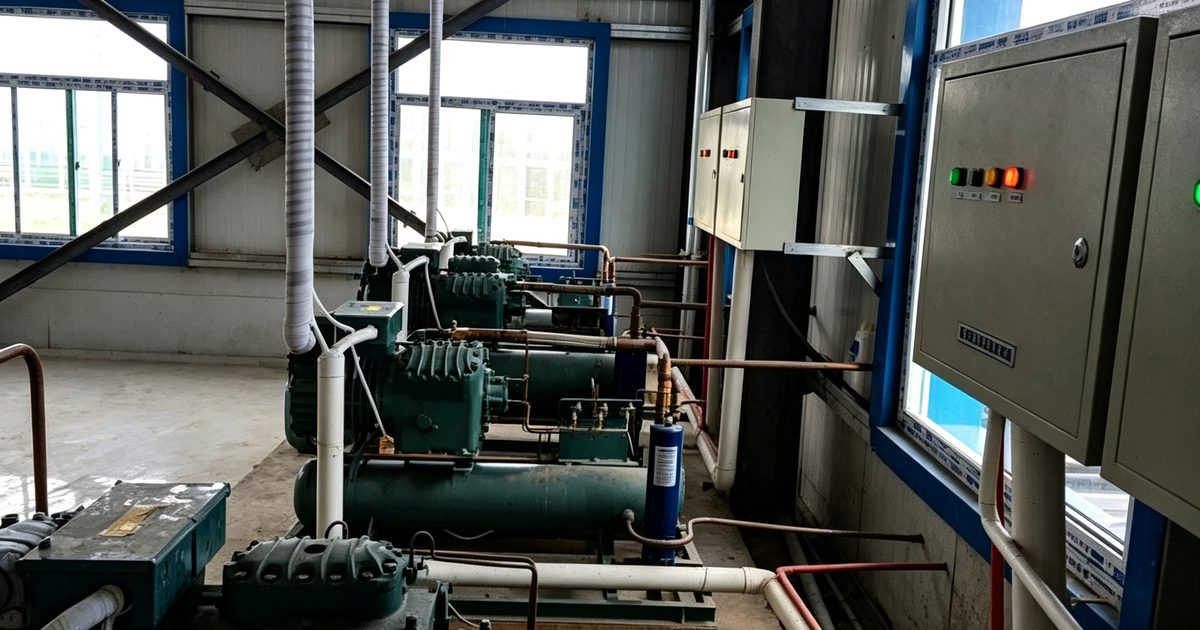
The refrigeration plant for a CA room is usually similar to an equivalent cold store, sometimes with a slightly higher evaporator surface area to minimise temperature swing. The CA-specific equipment is separate, and it is where most of the extra budget goes.
| Equipment | Function | What to check in the quotation |
|---|---|---|
| Nitrogen generator (PSA or membrane) | Produces N₂ on site to flush O₂ down | Is it PSA or membrane? PSA reaches lower O₂; membrane is cheaper but often caps out around 2–3% |
| CO₂ scrubber | Removes excess CO₂ produced by respiration | Is it sized for peak respiration in the first weeks, not the average? |
| O₂ / CO₂ analyser | Measures room atmosphere, the basis for all control | Is it a dedicated analyser or a portable handset? Are there sampling lines from every room? |
| Control system | Automates flushing, scrubbing and logging | Does it log? Can you export the record for a buyer's audit? |
| Pressure relief / safety | Protects structure, allows safe entry | Is there a positive lockout and an O₂ alarm at the door for personnel entry? |
Engineering tip: Size the nitrogen generator on the pull-down requirement, not on holding. Flushing a loaded room from 21% down to 2% in the target number of days is a much larger gas demand than maintaining 2% afterwards. Undersized generators are the most common reason a new CA room misses its start date.
The safety point deserves emphasis. A CA room is a confined space with an atmosphere that does not support life. Any CA installation needs a personnel-entry procedure, an O₂ alarm, and forced ventilation before anyone goes inside. If a supplier's proposal does not mention entry safety, that is a red flag about the rest of the specification.
Storage parameters for common crops
Parameters vary by cultivar and by region, and they should be confirmed with your local extension or storage specialist. These are the starting ranges most buyers work from.
| Crop | Temperature | O₂ | CO₂ | Practical notes |
|---|---|---|---|---|
| Apple (most cultivars) | 0–1 °C | 1.5–2.5% | 1–3% | The classic CA crop; some cultivars are CO₂-sensitive and need <1% |
| Pear | −0.5 to 0 °C | 2–3% | <1% | Very CO₂-sensitive; higher CO₂ causes internal breakdown |
| Kiwifruit | 0 °C | 2% | 3–5% | Tolerates higher CO₂; benefits from ethylene removal |
| Cherry | 0–1 °C | 3–5% | 5–10% | Short storage; high CO₂ extends firmness |
| Cabbage | 0–1 °C | 3–5% | 5–7% | Used for long holding of stored cabbage |
| Onion | 0–1 °C | 3% | 5% | Usually combined with low humidity control |
Two parameters are routinely ignored by buyers and then regretted: ethylene removal and humidity. Many CA programmes include an ethylene scrubber or catalytic converter, particularly for kiwifruit and apples. Humidity in a CA room is usually held at 90–95% RH to limit weight loss, which is a separate design input from the gas system and needs to be stated.
Costs and lead time
It is tempting to ask "what does a CA room cost per square metre", and suppliers will answer — but the number is only meaningful once the storage class is fixed.
The realistic cost drivers, in order of impact:
- Storage class — a 3% CA room costs meaningfully less than a 1.2% ULO room for the same volume, because of the envelope and analyser requirements.
- Number of separate rooms — CA economics favour several smaller rooms over one large one. You can store different cultivars and different storage durations separately, and one room can be emptied without breaking the atmosphere of the others.
- CA equipment origin and capacity — imported analysers and PSA generators cost more and have longer lead times than local alternatives, and the difference is often justified by lower O₂ capability.
- Room height and pallet layout — higher rooms hold more pallets per square metre of floor, but they also hold more air volume to flush and require more refrigeration.
- Local construction and power supply — three-phase power sized for the added CA load is a recurring site constraint.
Lead time on a complete CA project, from signed order to first fruit loaded, is typically several months — panel fabrication, site work, the CA equipment package, and commissioning all run in sequence. If you are planning for a specific harvest, work backwards from that date and add margin for the pressure test and any re-sealing it reveals.
Eight questions to answer before you request a quotation
- What crop, and which cultivars? Cultivar determines the CO₂ tolerance, which determines the whole specification.
- What target O₂ level — 3% CA, 1.5% ULO, or dynamic?
- How many months of storage, and will you market from the room or hold it closed until a fixed date?
- How many rooms, and what volume each? This is a commercial decision as much as an engineering one.
- Pallet positions and pallet height, including whether you stack two-high.
- What is the loading window — how many days do you have to fill the room? This sets the pull-down capacity.
- Is ethylene removal and humidity control required, or just O₂/CO₂?
- Who operates the room, and at what skill level? A ULO room operated by an untrained team will perform worse than a standard CA room operated well.
Suppliers who ask these questions before quoting are usually the ones who have built CA rooms before. Suppliers who quote from a floor area and a temperature alone are quoting you a cold store.
Frequently asked questions
Is CA storage worth the extra investment? It depends entirely on your market window. CA storage only pays back if you are actually holding fruit into a period when supply is short and price is higher. If you sell everything within two months of harvest, ordinary cold storage with good humidity control will return more on the same capital.
Can an existing cold room be converted to CA? Sometimes, but it is rarely economical. Converting means re-sealing every panel joint, replacing the door with a gas-tight CA door, sealing the floor and penetrations, and then pressure-testing. On a room that was not detailed for sealing at construction, the retrofit cost often approaches a large fraction of a new room, and the result carries more risk.
What is the difference between PSA and membrane nitrogen generation? Pressure swing adsorption (PSA) produces higher-purity nitrogen and can pull O₂ lower, which is what ULO rooms need. Membrane systems are simpler and cheaper but typically reach O₂ levels around 2–3%, which suits standard CA but not ULO.
How is O₂ measured, and how often should analysers be calibrated? Rooms are sampled through dedicated lines to a central analyser, or checked with a portable unit. Analyser drift is a real cause of crop loss — a room reading 2% when the true figure is 0.8% can damage fruit. Follow the manufacturer's calibration interval and keep a calibration log.
Does CA storage replace refrigeration? No. CA slows respiration; it does not remove heat. A CA room still needs full refrigeration capacity sized for the pull-down, and the room must hold temperature as tightly as an ordinary cold store. Poor temperature control combined with CA is worse than either problem alone.
Getting a CA room specified properly
Controlled atmosphere storage is one of the few cold storage investments where the specification details decide the outcome more than the brand of the equipment. Get the storage class, the envelope standard and the crop parameters agreed first, and the rest of the quotation becomes comparable between suppliers.
Shandong Boruite Refrigeration manufactures and installs CA and ULO storage rooms, including the gas-tight envelope, PSA nitrogen generation, CO₂ scrubbing and analyser packages. Send us your crop, cultivar, target storage duration, pallet count and loading window, and we will return a specification you can compare line by line — including the pressure test acceptance criterion.
Request a CA storage quotation · Browse CA storage projects
Send us the product, storage volume, target temperature and site conditions — our engineers will come back with a preliminary scheme and budget range within 24 hours.
Email us 15898896999